| Vendor | |
|---|---|

|
Liepman Literary Agency
Marc Koralnik |
| Original language | |
| English | |
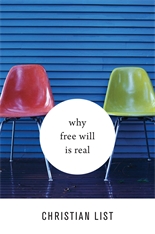
WHY FREE WILL IS REAL
A crystal-clear, scientifically rigorous argument for the existence of free will, challenging what many scientists and scientificallyminded philosophers believe.
Philosophers have argued about the nature and existence of free will at least since Plato. Today, scientists and scientifically-minded philosophers tend to be skeptical that it exists, especially when it is understood to require the ability to choose between alternative possibilities. If the laws of physics govern everything that happens, they argue, then how can our choices be free? Believers in free will must be misled by habit, sentiment, or religious doctrine. Why Free Will Is Real defies scientific orthodoxy and presents a bold new defense of free will in the same naturalistic terms that are usually deployed against it.
Unlike those who defend free will by giving up the idea that it requires alternative possibilities to choose from, Christian List retains this idea as central, resisting the tendency to defend free will by watering it down. He concedes that free will and its prerequisitesintentional agency, alternative possibilities, and causal control over our actions cannot be found among the fundamental physical features of the natural world. But, he argues, that's not where we should be looking. Free will is a higher-level phenomenon found at the level of
psychology. It is like other phenomena that emerge from physical laws but are autonomous from them and not best understood in fundamental termslike an ecosystem or the economy. When we discover it in its proper context, acknowledging that free will is real is not just scientifically respectable; it is indispensable for explaining our world.
Christian List is Professor of Philosophy and Political Science at the London School of Economics and Political Science and a Fellow of the British Academy.
Unlike those who defend free will by giving up the idea that it requires alternative possibilities to choose from, Christian List retains this idea as central, resisting the tendency to defend free will by watering it down. He concedes that free will and its prerequisitesintentional agency, alternative possibilities, and causal control over our actions cannot be found among the fundamental physical features of the natural world. But, he argues, that's not where we should be looking. Free will is a higher-level phenomenon found at the level of
psychology. It is like other phenomena that emerge from physical laws but are autonomous from them and not best understood in fundamental termslike an ecosystem or the economy. When we discover it in its proper context, acknowledging that free will is real is not just scientifically respectable; it is indispensable for explaining our world.
Christian List is Professor of Philosophy and Political Science at the London School of Economics and Political Science and a Fellow of the British Academy.
| Available products |
|---|
|
Book
Published 2019-05-01 by Harvard University Press |