| Vendor | |
|---|---|

|
Mohrbooks Literary Agency
Sebastian Ritscher |
| Original language | |
| English | |
| Weblink | |
| www.ted.com/talks/sandra_aamodt_ … | |
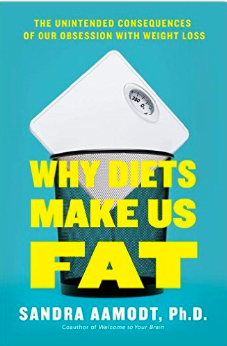
WHY DIETS MAKE US FAT
The Unintended consequences of Our Obsession With Weight Loss
Based on her viral TED Talk, neuroscientist and science writer Sandra Aamodt explains here how the latest research contradicts what we think we know about dieting and weight loss.
We think we know the answer to weight loss: Cut calories. Eat less. We conclude that fat is a failure of willpower, perhaps supplemented by a quirk of genetics. But in WHY DIETS MAKE US FAT, Sandra Aamodt explains why dieting not only doesn’t work, but is likely to do more harm than good.
• When you diet, your brain thinks you’re starving and goes into survival mode. People who have gone on extreme diets may never lose their food obsession as a result, even if they go back to eating normally.
• The long-term failure rate for losing weight by willpower dieting is between 80-98%, depending on how you define success.
• There’s no evidence that dieting improves long-term health, while some research suggests that weight cycling, or dieting to lose weight and gaining it back, can be more dangerous than being overweight itself.
• It’s better to be fifty pounds overweight and exercise every day than it is to be at your “target weight” but sedentary.
By harnessing her knowledge of brain science and biology, Aamodt successfully stabilized her own weight at a healthy level and now enjoys a better relationship with food. Combining deep research and brutal candor about her experiences, Aamodt gives us several clues into the obesity epidemic, including new findings about gut bacteria, why bariatric surgery works, and what a real alternative to dieting and weight cycling looks like.
Sandra ASandra Aamodt coauthored Welcome to Your Brain and Welcome to Your Child’s Brain. She was the editor in chief of Nature Neuroscience, a leading scientific journal in the field of brain research. She received her undergraduate degree in biophysics from Johns Hopkins University and her doctorate in neuroscience from the University of Rochester. Her science writing has been published in The New York Times, The Washington Post, El Mundo and The Times of London, among others.
• When you diet, your brain thinks you’re starving and goes into survival mode. People who have gone on extreme diets may never lose their food obsession as a result, even if they go back to eating normally.
• The long-term failure rate for losing weight by willpower dieting is between 80-98%, depending on how you define success.
• There’s no evidence that dieting improves long-term health, while some research suggests that weight cycling, or dieting to lose weight and gaining it back, can be more dangerous than being overweight itself.
• It’s better to be fifty pounds overweight and exercise every day than it is to be at your “target weight” but sedentary.
By harnessing her knowledge of brain science and biology, Aamodt successfully stabilized her own weight at a healthy level and now enjoys a better relationship with food. Combining deep research and brutal candor about her experiences, Aamodt gives us several clues into the obesity epidemic, including new findings about gut bacteria, why bariatric surgery works, and what a real alternative to dieting and weight cycling looks like.
Sandra ASandra Aamodt coauthored Welcome to Your Brain and Welcome to Your Child’s Brain. She was the editor in chief of Nature Neuroscience, a leading scientific journal in the field of brain research. She received her undergraduate degree in biophysics from Johns Hopkins University and her doctorate in neuroscience from the University of Rochester. Her science writing has been published in The New York Times, The Washington Post, El Mundo and The Times of London, among others.
| Available products |
|---|
|
Book
Published 2016-06-07 by Current |
|
Book
Published 2016-06-07 by Current |