| Vendor | |
|---|---|

|
Fritz Agency
Christian Dittus |
| Original language | |
| English | |
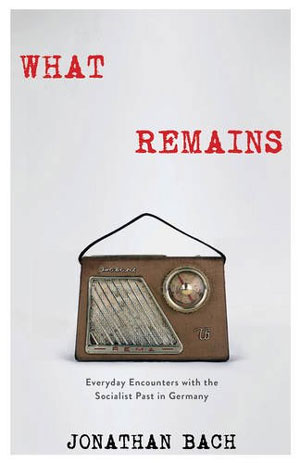
WHAT REMAINS
Everyday Encounters with the Socialist Past in Germany
What happens when an entire modern state's material culture becomes abruptly obsolete? How do ordinary people encounter what remains? In this ethnography, Jonathan Bach examines the afterlife of East Germany following the fall of the Berlin Wall, as things and places from that vanished socialist past continue to circulate and shape the politics of memory.
WHAT REMAINS traces the unsettling effects of these unmoored artifacts on the German present, arguing for a rethinking of the role of the everyday as a site of reckoning with difficult pasts. Bach juxtaposes four sites where the stakes of the everyday appear: products commodified as nostalgia, amateur museums dedicated to collecting everyday life under socialism, the "people's palace" that captured the national imagination through its destruction, and the feared and fetishized Berlin Wall. Moving from the local, the intimate, and small to the national, the impersonal, and large, this book's interpenetrating chapters show the unexpected social and political force of the ordinary in the production of memory. What Remains offers a unique vantage point on the workings of the everyday in situations of radical discontinuity, contributing to new understandings of postsocialism and the intricate intersection of material remains and memory.
Jonathan Bach is an associate professor of international affairs and chair of the interdisciplinary global studies undergraduate program at the New School. He has held visiting positions at, among institutions, the Center for Literature and Cultural Studies in Berlin and the Institute for Peace Research and Security Studies in Hamburg. Jonathan Bach speaks German fluently.
DIE SPUREN DER DDR
Von Ostproduktion bis zu
den Resten der Berliner Mauer
Deutsch von Ursula Blank-Sangmeister
unter Mitarbeit von Anna Raupach und Janet Schueffel
[HC Reclam 02/19; ]
WHAT REMAINS traces the unsettling effects of these unmoored artifacts on the German present, arguing for a rethinking of the role of the everyday as a site of reckoning with difficult pasts. Bach juxtaposes four sites where the stakes of the everyday appear: products commodified as nostalgia, amateur museums dedicated to collecting everyday life under socialism, the "people's palace" that captured the national imagination through its destruction, and the feared and fetishized Berlin Wall. Moving from the local, the intimate, and small to the national, the impersonal, and large, this book's interpenetrating chapters show the unexpected social and political force of the ordinary in the production of memory. What Remains offers a unique vantage point on the workings of the everyday in situations of radical discontinuity, contributing to new understandings of postsocialism and the intricate intersection of material remains and memory.
Jonathan Bach is an associate professor of international affairs and chair of the interdisciplinary global studies undergraduate program at the New School. He has held visiting positions at, among institutions, the Center for Literature and Cultural Studies in Berlin and the Institute for Peace Research and Security Studies in Hamburg. Jonathan Bach speaks German fluently.
DIE SPUREN DER DDR
Von Ostproduktion bis zu
den Resten der Berliner Mauer
Deutsch von Ursula Blank-Sangmeister
unter Mitarbeit von Anna Raupach und Janet Schueffel
[HC Reclam 02/19; ]
| Available products |
|---|
|
Book
Published 2017-08-01 by Columbia University Press |