| Vendor | |
|---|---|

|
Mohrbooks Literary Agency
Sebastian Ritscher |
| Original language | |
| English | |
| Categories | |
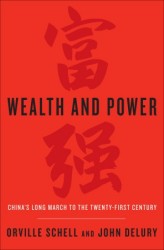
WEALTH & POWER
China's Long March to the Twenty-First Century
A thought-provoking book from two of the foremost experts on China. Unlike the many other books on China, this is not merely a history book or a soothsaying prediction for the future, but a deeply researched – and no doubt controversial-- account of how and why China became the superpower it is today, and what that means for the rest of the world.
The missing link in the large catalogue of histories of modern China is a readable interpretation of how China managed to arrive at its current phase of dynamic economic growth.
How, after such a long and tortured interregnum of dynastic collapse, national weakness, intellectual upheaval, revolution, foreign occupation, civil war and political turmoil, did the "sick man of Asia" succeed in breaking out of its old patterns of failed reform and at last burst forth into its present stage of hyper-development and wealth-creation? To answer this question, WEALTH & POWER looks to the past to understand what the forces were that finally succeeded in coming together to culminate in this moment. It presents a sampling of the iconic intellectual figures and political leaders of Chinese history over the last 150 years and examines what they thought and did as Chinese society made its tortured progress through the twentieth century.
So much of China's success has ended up depending on some of the most destructive periods of China's most extreme revolutionary period. The conventional wisdom has been that, especially during the Cultural Revolution when China's leaders were set on designating as "feudal" (and subsequently razing) everything that had formerly made-up Chinese culture for the past four millennia, the destructive periods were simply nihilistic episodes that set China back. But, Delury and Schell argue that it was precisely these periods of nihilism--what Joseph Schumpeter might have viewed as an interim of "creative destruction"--that enabled China to finally break loose, without quite realizing what it was doing and where it was going, from the powerful gravity of the old Confucian social, political and moral order that had for so long acted as a drag on China's ability to truly reconceive itself in a modern guise.
What Chinese have actually been struggling toward since the 1870s has not so much been democracy, equality or human rights, but fuqiang, "wealth and power," a uniquely Chinese leitmotif that keeps reoccuring throughout its modern history.
For Chinese reformers, democracy was often important, but of usually only oblique interest in so far as it offered a means to this other more important end, namely, a restoration of a measure of Chinese "greatness." Thus, democracy tended not to become so much an immediate goal that was idealized in its own right (in the same way Westerners came to idealize liberté, egalité et fraternité especially after the French Revolution) but a means to an end. Likewise the Communist revolution, and the unique brand of socialism that grew in Chinese soil, employed an instrumentalist version of Marx-Leninism. Mao promised that the communist road would enable China, at long last, to stand up in the world, and then surpass Britain, the USSR and the USA. At the core of virtually every great Chinese leader's vision of the country's future, one finds the yearning to achieve "wealth and power," and a view of all else as a means to that end. Orville Schell, longtime China correspondent for The New Yorker and author of more than a dozen books, has written for many journals and magazines, including The New Yorker, Wired, the New York Review of Books, Harper's, the New York Times, the Atlantic, and Newsweek. Formerly the dean of the Graduate School of Journalism at the University of California at Berkeley, he is currently the Arthur Ross Director of the Asia Society's Center on U.S.-China relations. He divides his time between Manhattan and Berkeley, California.
John Delury received his Ph.D in modern Chinese history at Yale University, where he wrote his dissertation on the Ming-Qing Confucian philosopher, Gu Yanwu. He taught history at Brown University and then politics at Columbia University. He has been the Associate Director of the Center on US-China Relations at the Asia Society in New York City for the past two years.
How, after such a long and tortured interregnum of dynastic collapse, national weakness, intellectual upheaval, revolution, foreign occupation, civil war and political turmoil, did the "sick man of Asia" succeed in breaking out of its old patterns of failed reform and at last burst forth into its present stage of hyper-development and wealth-creation? To answer this question, WEALTH & POWER looks to the past to understand what the forces were that finally succeeded in coming together to culminate in this moment. It presents a sampling of the iconic intellectual figures and political leaders of Chinese history over the last 150 years and examines what they thought and did as Chinese society made its tortured progress through the twentieth century.
So much of China's success has ended up depending on some of the most destructive periods of China's most extreme revolutionary period. The conventional wisdom has been that, especially during the Cultural Revolution when China's leaders were set on designating as "feudal" (and subsequently razing) everything that had formerly made-up Chinese culture for the past four millennia, the destructive periods were simply nihilistic episodes that set China back. But, Delury and Schell argue that it was precisely these periods of nihilism--what Joseph Schumpeter might have viewed as an interim of "creative destruction"--that enabled China to finally break loose, without quite realizing what it was doing and where it was going, from the powerful gravity of the old Confucian social, political and moral order that had for so long acted as a drag on China's ability to truly reconceive itself in a modern guise.
What Chinese have actually been struggling toward since the 1870s has not so much been democracy, equality or human rights, but fuqiang, "wealth and power," a uniquely Chinese leitmotif that keeps reoccuring throughout its modern history.
For Chinese reformers, democracy was often important, but of usually only oblique interest in so far as it offered a means to this other more important end, namely, a restoration of a measure of Chinese "greatness." Thus, democracy tended not to become so much an immediate goal that was idealized in its own right (in the same way Westerners came to idealize liberté, egalité et fraternité especially after the French Revolution) but a means to an end. Likewise the Communist revolution, and the unique brand of socialism that grew in Chinese soil, employed an instrumentalist version of Marx-Leninism. Mao promised that the communist road would enable China, at long last, to stand up in the world, and then surpass Britain, the USSR and the USA. At the core of virtually every great Chinese leader's vision of the country's future, one finds the yearning to achieve "wealth and power," and a view of all else as a means to that end. Orville Schell, longtime China correspondent for The New Yorker and author of more than a dozen books, has written for many journals and magazines, including The New Yorker, Wired, the New York Review of Books, Harper's, the New York Times, the Atlantic, and Newsweek. Formerly the dean of the Graduate School of Journalism at the University of California at Berkeley, he is currently the Arthur Ross Director of the Asia Society's Center on U.S.-China relations. He divides his time between Manhattan and Berkeley, California.
John Delury received his Ph.D in modern Chinese history at Yale University, where he wrote his dissertation on the Ming-Qing Confucian philosopher, Gu Yanwu. He taught history at Brown University and then politics at Columbia University. He has been the Associate Director of the Center on US-China Relations at the Asia Society in New York City for the past two years.
| Available products |
|---|
|
Book
Published 2013-07-01 by Random House |
|
Book
Published 2013-07-01 by Random House |