| Vendor | |
|---|---|

|
Mohrbooks Literary Agency
Sebastian Ritscher |
| Original language | |
| English | |
| Categories | |
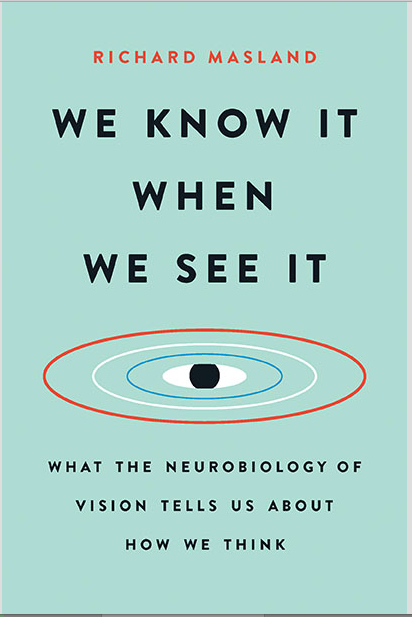
WE KNOW IT WHEN WE SEE IT
What the Neurobiology of Vision Tells US About How We Think
A fascinating look at how our brains understand the world. Richard Masland is a pioneering neuroscientist and a chaired professor of Ophthalmology and Neuroscience at Harvard Medical School, as well as a recipient of multiple awards for his contributions to neuroscience and vision. In WE KNOW IT WHEN WE SEE IT, he argues that understanding how vision works helps us understand one of neuroscience's most fundamental questions: how the brain learns without external help.
Spotting a face in a crowd is easy. We can do it from almost any angle, up close or far away, in person or in a picture. We do it so often that we take it for granted.
But object recognition, the neural process that enables us to find that face, is hard. Your brain is small and slow. It has neither the time nor the capacity to store and recall whole images of everything you see from every possible angle. Instead, brains work by figuring out what is important to see and what isn't. And they must be able to figure this out on their own, without guidance from anything else. So in order to understand how you recognize your friend at a party, your suitcase on a luggage carousel, or a suspicious person waiting in the shadows, you first must understand how your brain teaches itself to see. The answer to that question explains how the brain learns nearly anything, and has the capacity to revolutionize our understanding of both human and artificial intelligence.
We Know It When We See It unravels these mysteries by exploring the strange and mind-bending processes of human vision. The key insight is that learning is shaped by need. Our brains have evolved basic ways of processing information, regulated by evolution. By applying these genetically determined rules to the basic mechanism of brain cells - a long-ignored but visionary concept known as the Hebb synapse - our brains gain enough innate guidance to begin making sense of the world around them without any help, and to learn new things.
Covering everything from what happens when photons hit your retina, to the neuroplasticity of real nerve nets, to what a computer algorithm must be able to do before it can mimic neural nets and be called "intelligent," to why some people have neurons that only fire in response to Jennifer Aniston's face, We Know It When We See It is a deep and thoughtful examination of how our brains make sense of the world.
Richard Masland is the David Glendenning Cogan Distinguished Professor of Ophthalmology and Professor of Neuroscience at Harvard Medical School. For many years he was Director of Research at the Massachusetts Eye and Ear Infirmary, the world's largest vision research institute. He is a fellow of the AAAS, a former Howard Hughes Medical Institute investigator, and a recipient of the Proctor Medal and Alcon Research Award, among others. Masland has made groundbreaking contributions to the study of neural networks and to the reversal of blindness. He divides his time between Boston and Frenchtown, Maryland.
But object recognition, the neural process that enables us to find that face, is hard. Your brain is small and slow. It has neither the time nor the capacity to store and recall whole images of everything you see from every possible angle. Instead, brains work by figuring out what is important to see and what isn't. And they must be able to figure this out on their own, without guidance from anything else. So in order to understand how you recognize your friend at a party, your suitcase on a luggage carousel, or a suspicious person waiting in the shadows, you first must understand how your brain teaches itself to see. The answer to that question explains how the brain learns nearly anything, and has the capacity to revolutionize our understanding of both human and artificial intelligence.
We Know It When We See It unravels these mysteries by exploring the strange and mind-bending processes of human vision. The key insight is that learning is shaped by need. Our brains have evolved basic ways of processing information, regulated by evolution. By applying these genetically determined rules to the basic mechanism of brain cells - a long-ignored but visionary concept known as the Hebb synapse - our brains gain enough innate guidance to begin making sense of the world around them without any help, and to learn new things.
Covering everything from what happens when photons hit your retina, to the neuroplasticity of real nerve nets, to what a computer algorithm must be able to do before it can mimic neural nets and be called "intelligent," to why some people have neurons that only fire in response to Jennifer Aniston's face, We Know It When We See It is a deep and thoughtful examination of how our brains make sense of the world.
Richard Masland is the David Glendenning Cogan Distinguished Professor of Ophthalmology and Professor of Neuroscience at Harvard Medical School. For many years he was Director of Research at the Massachusetts Eye and Ear Infirmary, the world's largest vision research institute. He is a fellow of the AAAS, a former Howard Hughes Medical Institute investigator, and a recipient of the Proctor Medal and Alcon Research Award, among others. Masland has made groundbreaking contributions to the study of neural networks and to the reversal of blindness. He divides his time between Boston and Frenchtown, Maryland.
| Available products |
|---|
|
Book
Published 2020-03-01 by Basic Books |