| Vendor | |
|---|---|

|
Mohrbooks Literary Agency
Sebastian Ritscher |
| Original language | |
| English | |
| Categories | |
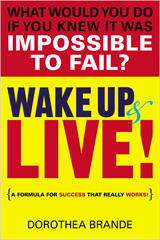
WAKE UP AND LIVE!
In WAKE UP AND LIVE!—a book that is as enjoyable as its formula is simple—Brande tells the story of her discovery and shows how her eight-word technique can be applied across different areas of life. With its observations about self-defeat and its powerful idea for navigating around it, it is one of the most keenly argued and carefully observant works of practical psychology ever written.
This magic key is at the heart of one of the most persuasive self-improvement books ever published: a work that, though now forgotten, once rivaled the popularity of contemporaneous books by Napoleon Hill and Dale Carnegie.
When Dorothea Brande published WAKE UP AND LIVE! in 1936, the book soared to popularity, selling over a millioncopies in the years ahead. The book won so much acclaim that it became the sole work of mind-power philosophy ever to make it to the movie screen—and as a musical, no less! In 1937, 20th Century Fox released Wake Up and Live, starring Walter Winchell.
Brande was a journalist and writing instructor by trade, best known for herenduring and thoughtful instructional book, Becoming a Writer (1934). That book, Brande explained, grew out of a period of bounding productivity in her career, which began with her discovery of one basic law of success. Brande’s formula (“act as if it were impossible to fail”) was so simple and magical-seeming that it made people want to argue with her the moment she uttered it. But for many it worked.
Brande was a preternaturally sharp-eyed student of human nature. She detected among the vast majority of men and women a “will to fail.” Thisdamning wish grew from a little-seen foible of human nature. We are, Brandeinsisted, more frightened of suffering humiliation than desirous of achievement. When fear and ambition clash, she argued, fear inevitably prevails. “The Unconscious dreads pain, humiliation, fatigue,” Brande wrote; “it bends its efforts even more ceaselessly to the end of avoiding pain than it does to the procuring of positive pleasures.”
Rather than risk rejection, people often self-sabotage: blowing deadlines, alienating allies, aimlessly procrastinating. Brande’s grasp of the psychology of failure brought her a “eureka” moment. After a lifetime of searching she had found the answer.
Born in Chicago, Dorothea Brande (1893-1948) was a widely respected journalist, fiction author, and writing instructor. She is widely known for her enduring guide to the creative process, Becoming a Writer, originally published in 1934 and still popular today. In 1936, Brande published a masterwork of practical psychology, WAKE UP AND LIVE! The book entered more than 34 printings and sold over 1,000,000 copies. For many years, WAKE UP AND LIVE!, with its simple and sound advice for personal excellence, rivaled the popularity of contemporaneous works such as Think and Grow Rich and How to Win Friends and Influence People. This classic of self-improvement is back in print for the first time in many years with this new edition.
When Dorothea Brande published WAKE UP AND LIVE! in 1936, the book soared to popularity, selling over a millioncopies in the years ahead. The book won so much acclaim that it became the sole work of mind-power philosophy ever to make it to the movie screen—and as a musical, no less! In 1937, 20th Century Fox released Wake Up and Live, starring Walter Winchell.
Brande was a journalist and writing instructor by trade, best known for herenduring and thoughtful instructional book, Becoming a Writer (1934). That book, Brande explained, grew out of a period of bounding productivity in her career, which began with her discovery of one basic law of success. Brande’s formula (“act as if it were impossible to fail”) was so simple and magical-seeming that it made people want to argue with her the moment she uttered it. But for many it worked.
Brande was a preternaturally sharp-eyed student of human nature. She detected among the vast majority of men and women a “will to fail.” Thisdamning wish grew from a little-seen foible of human nature. We are, Brandeinsisted, more frightened of suffering humiliation than desirous of achievement. When fear and ambition clash, she argued, fear inevitably prevails. “The Unconscious dreads pain, humiliation, fatigue,” Brande wrote; “it bends its efforts even more ceaselessly to the end of avoiding pain than it does to the procuring of positive pleasures.”
Rather than risk rejection, people often self-sabotage: blowing deadlines, alienating allies, aimlessly procrastinating. Brande’s grasp of the psychology of failure brought her a “eureka” moment. After a lifetime of searching she had found the answer.
Born in Chicago, Dorothea Brande (1893-1948) was a widely respected journalist, fiction author, and writing instructor. She is widely known for her enduring guide to the creative process, Becoming a Writer, originally published in 1934 and still popular today. In 1936, Brande published a masterwork of practical psychology, WAKE UP AND LIVE! The book entered more than 34 printings and sold over 1,000,000 copies. For many years, WAKE UP AND LIVE!, with its simple and sound advice for personal excellence, rivaled the popularity of contemporaneous works such as Think and Grow Rich and How to Win Friends and Influence People. This classic of self-improvement is back in print for the first time in many years with this new edition.
| Available products |
|---|
|
Book
Published 2013-09-01 by Tarcher |
|
Book
Published 2013-09-01 by Tarcher |