| Vendor | |
|---|---|

|
Mohrbooks Literary Agency
Sebastian Ritscher |
| Original language | |
| English | |
| Categories | |
| Weblink | |
| www.edwardconard.com/ | |
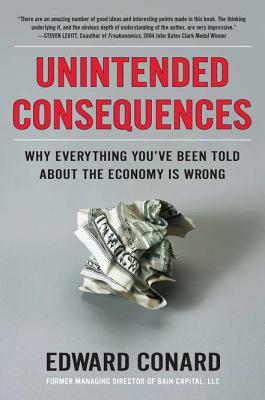
UNINTENDED CONSEQUENCES
Why Everything You?ve Been Told about the Economy is Wrong
Was America's economic success over the last twenty-five years built on false pretenses? Did we simply borrow and spend too much money? Are we now paying the price of that unsustainable spending spree?
In the aftermath of the Financial Crisis, many have had tried to explain what caused it. Wall Street bankers stand accused of using low down payments, teaser rates and other predatory tactics to seduce homeowners while US households are blamed for increasing consumption to unsustainable levels by lowering savings rates and borrowing recklessly. As a result, some economists claim, low household savings rates and a corresponding lack of investment eroded US competitiveness, while open trade borders and cheap offshore labor seem to have prevented US workers especially unskilledworkers from successfully demanding higher pay. To add insult to injury, the tax policies of the Reagan and Bush administrations appear to have allowed reckless risk-takers to keep an unfair share of these ill-gotten gains.
Something had to give, didn't it? No less than thecredibility of capitalism is at stake. Now we wonder whether free markets optimize on their own and if private investors unnecessarily put our economy at risk solely for their own gains.
Operating from this perspective, we need to regulate risk-taking. Politicians should raise taxes on the rich and use the proceeds to shore up social spending. This is the moral and fair solution and will prevent another crisis from happening by keeping the market under control.
But according to investment expert Ed Conard, while thisnarrative may sound convincing, it leaves many questions unanswered. For instance, if the United States became a nation of consumers rather than investors, why did productivity soar in the years leading up to the meltdown? If predatory bankers took advantage of homeowners why did down payments decline, thereby shifting risk from homeowners to lenders? If the risks were easy to spot, why did top financial advisors encourage lenders to keep making unsound investments? In an attempt to set the record straight and fill the void left by other economic analysts, Conard presents a mosaic of information to explain how the economy works, why the United States has outperformed other countries, what caused the Financial Crisis, and what improvements might better protect our economy without damaging growth.
Ed Conard was a partner at Bain Capital from 1993 to 2007. While there he served as head of Bain's New York office and led Bain's acquisitions of large industrial companies. He sits on severalboards of directors including the boards of Waters Corporation and Sensata Technologies. Prior to Bain, Conard worked for Wasserstein Perella, a Wall Street investment bank that specialized in mergers and acquisitions. Conardgraduated with distinction from Harvard Business School and holds an undergraduate degree in engineering from The University of Michigan. He lives in New York with his wife and daughter.
Something had to give, didn't it? No less than thecredibility of capitalism is at stake. Now we wonder whether free markets optimize on their own and if private investors unnecessarily put our economy at risk solely for their own gains.
Operating from this perspective, we need to regulate risk-taking. Politicians should raise taxes on the rich and use the proceeds to shore up social spending. This is the moral and fair solution and will prevent another crisis from happening by keeping the market under control.
But according to investment expert Ed Conard, while thisnarrative may sound convincing, it leaves many questions unanswered. For instance, if the United States became a nation of consumers rather than investors, why did productivity soar in the years leading up to the meltdown? If predatory bankers took advantage of homeowners why did down payments decline, thereby shifting risk from homeowners to lenders? If the risks were easy to spot, why did top financial advisors encourage lenders to keep making unsound investments? In an attempt to set the record straight and fill the void left by other economic analysts, Conard presents a mosaic of information to explain how the economy works, why the United States has outperformed other countries, what caused the Financial Crisis, and what improvements might better protect our economy without damaging growth.
Ed Conard was a partner at Bain Capital from 1993 to 2007. While there he served as head of Bain's New York office and led Bain's acquisitions of large industrial companies. He sits on severalboards of directors including the boards of Waters Corporation and Sensata Technologies. Prior to Bain, Conard worked for Wasserstein Perella, a Wall Street investment bank that specialized in mergers and acquisitions. Conardgraduated with distinction from Harvard Business School and holds an undergraduate degree in engineering from The University of Michigan. He lives in New York with his wife and daughter.
| Available products |
|---|
|
Book
Published 2012-06-01 by Portfolio |
|
Book
Published 2012-06-01 by Portfolio |