| Vendor | |
|---|---|

|
Liepman Literary Agency
Marc Koralnik |
| Original language | |
| English | |
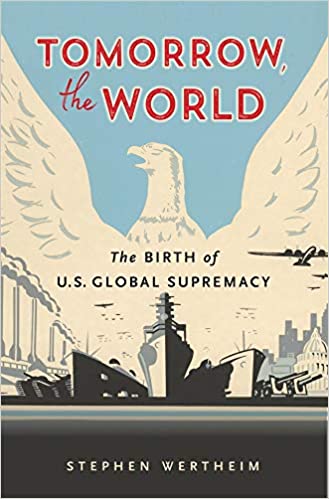
TOMORROW, THE WORLD
The Birth of U.S. Global Supremacy
A new history explains how and why, as it prepared to enter World War II, the United States decided to lead the postwar world.
For most of its history, the United States avoided making political and military commitments that would entangle it in European-style power politics. Then, suddenly, it conceived a new role for itself as the world's armed superpowerand never looked back. In Tomorrow, the World, Stephen Wertheim traces America's transformation to the crucible of World War II, especially in the months prior to the attack on Pearl Harbor. As the Nazis conquered France, the architects of the nation's new foreign policy came to believe that the United States ought to achieve primacy in international affairs forevermore.
Scholars have struggled to explain the decision to pursue global supremacy. Some deny that American elites made a willing choice, casting the United States as a reluctant power that sloughed off isolationism only after all potential competitors lay in ruins. Others contend that the United States had always coveted global dominance and realized its ambition at the first opportunity. Both views are wrong. As late as 1940, the small coterie of officials and experts who composed the US foreign policy class either wanted British preeminence in global affairs to continue or hoped that no power would dominate. The war, however, swept away their assumptions, leading them to conclude that the United States should extend its form of law and order across the globe and back it at gunpoint. Wertheim argues that no one favored isolationisma term introduced by advocates of armed supremacy in order to turn their own cause into the definition of a new internationalism.
We now live, Wertheim warns, in the world that these men created. A sophisticated and impassioned narrative that questions the wisdom of US supremacy, Tomorrow, the World reveals the intellectual path that brought us to today's global entanglements and endless wars.
STEPHEN WERTHEIM is Deputy Director of Research and Policy at the Quincy Institute for Responsible Statecraft and Research Scholar at the Saltzman Institute of War and Peace Studies at Columbia University. His writing has appeared in Foreign Affairs, Foreign Policy, New York Review of Books, New York Times, and Washington Post.
Scholars have struggled to explain the decision to pursue global supremacy. Some deny that American elites made a willing choice, casting the United States as a reluctant power that sloughed off isolationism only after all potential competitors lay in ruins. Others contend that the United States had always coveted global dominance and realized its ambition at the first opportunity. Both views are wrong. As late as 1940, the small coterie of officials and experts who composed the US foreign policy class either wanted British preeminence in global affairs to continue or hoped that no power would dominate. The war, however, swept away their assumptions, leading them to conclude that the United States should extend its form of law and order across the globe and back it at gunpoint. Wertheim argues that no one favored isolationisma term introduced by advocates of armed supremacy in order to turn their own cause into the definition of a new internationalism.
We now live, Wertheim warns, in the world that these men created. A sophisticated and impassioned narrative that questions the wisdom of US supremacy, Tomorrow, the World reveals the intellectual path that brought us to today's global entanglements and endless wars.
STEPHEN WERTHEIM is Deputy Director of Research and Policy at the Quincy Institute for Responsible Statecraft and Research Scholar at the Saltzman Institute of War and Peace Studies at Columbia University. His writing has appeared in Foreign Affairs, Foreign Policy, New York Review of Books, New York Times, and Washington Post.
| Available products |
|---|
|
Book
Published 2020-10-01 by Harvard University Press |