| Vendor | |
|---|---|

|
Fritz Agency
Christian Dittus |
| Original language | |
| English | |
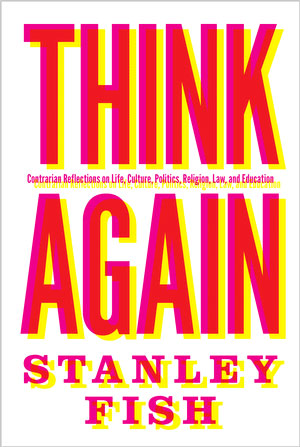
THINK AGAIN
Contrarian Reflections on Life, Culture, Politics, Religion, Law and Education
From 1995 to 2013, Stanley Fish's provocative New York Times columns consistently generated passionate discussion and debate. In THINK AGAIN, he has assembled almost one hundred of his best columns into a thematically arranged collection with a substantial new introduction that explains his intention in writing these pieces and offers an analysis of why they provoked so much reaction.
Some readers reported being frustrated when they couldn't figure out where Fish, one of America's most influential thinkers, stood on the controversies he addressed in the essaysfrom atheism and affirmative action to plagiarism and postmodernism. But, as Fish says, that is the point. Opinions are cheap; you can get them anywhere. Instead of offering just another set of them, Fish analyzes and dissects the arguments put forth by different sidesin debates over free speech, identity politics, the NRA, and other hot-button topicsin order to explain how their arguments work or don't work. In short, these are essays that teach you not what to think but how to think more clearly.
At the same time, the collection includes a number of revealing and even poignant autobiographical essays in which, as Fish says, readers will learn about my anxieties, my aspirations, my eccentricities, my foibles, my father, and my obsessionsFrank Sinatra, Ted Williams, basketball, and Jews.
Stanley Fish is the Davidson-Kahn Distinguished University Professor and Professor of Law at Florida International University and the Visiting Floersheimer Professor of Law at Cardozo Law School. He previously taught at Berkeley, Johns Hopkins, Duke, and the University of Illinois, Chicago.
Some readers reported being frustrated when they couldn't figure out where Fish, one of America's most influential thinkers, stood on the controversies he addressed in the essaysfrom atheism and affirmative action to plagiarism and postmodernism. But, as Fish says, that is the point. Opinions are cheap; you can get them anywhere. Instead of offering just another set of them, Fish analyzes and dissects the arguments put forth by different sidesin debates over free speech, identity politics, the NRA, and other hot-button topicsin order to explain how their arguments work or don't work. In short, these are essays that teach you not what to think but how to think more clearly.
At the same time, the collection includes a number of revealing and even poignant autobiographical essays in which, as Fish says, readers will learn about my anxieties, my aspirations, my eccentricities, my foibles, my father, and my obsessionsFrank Sinatra, Ted Williams, basketball, and Jews.
Stanley Fish is the Davidson-Kahn Distinguished University Professor and Professor of Law at Florida International University and the Visiting Floersheimer Professor of Law at Cardozo Law School. He previously taught at Berkeley, Johns Hopkins, Duke, and the University of Illinois, Chicago.
| Available products |
|---|
|
Book
Published 2015-10-01 by Princeton University Press |