| Vendor | |
|---|---|

|
Mohrbooks Literary Agency
Sebastian Ritscher |
| Original language | |
| English | |
| Categories | |
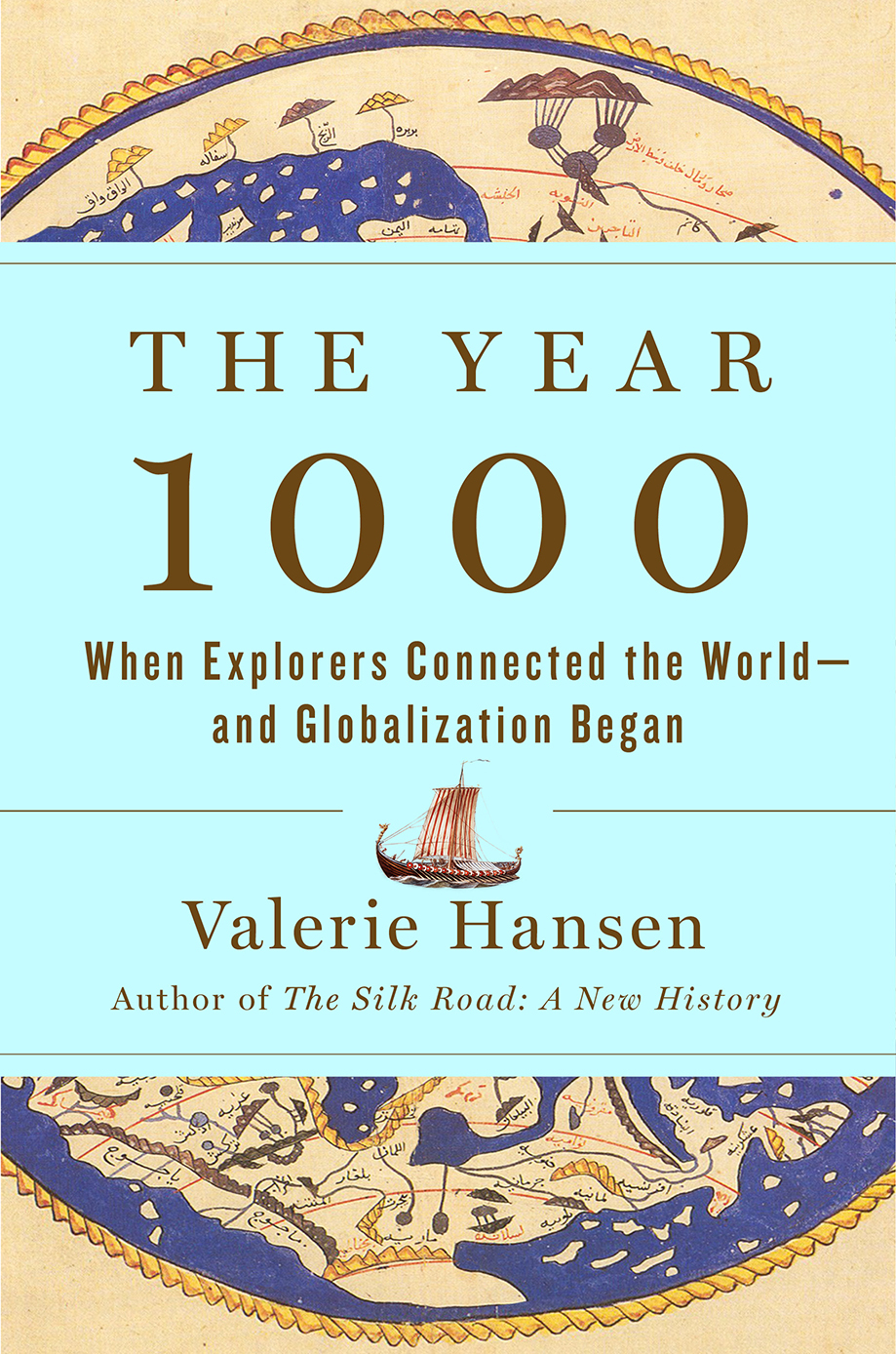
THE YEAR 1000
When Explorers Connected the World - and Globalization Began
Most observers believe that globalization began in 1492, the year Columbus discovered America. Yale historian Valerie Hansen argues in her groundbreaking new book, that it is more accurate to point to the year 1000 when new trade routes linked the entire globe, and an object could circumnavigate the world for the first time in history.
This book presents six pivotal encounters with long-term consequences that set the modern world in motion. Each chapter focuses on a separate voyager, explains which regions the new routes connected, and analyzes the impact of this regional expansion, an approach that allows the book to focus on both individuals and far-reaching changes.
The book moves around the world from west to east, looking at how each region made contacts with adjacent regions, beginning with Scandinavia and Northeastern Canada, then Europe, Africa, Asia and the Indian Ocean, and ending with the Maya in Mesoamerica. It starts with the Viking explorer Leif Erikson’s journey to the northern tip of Newfoundland and it ends with the rulers in Mesoamerica who created trade networks stretching south as far as Panama and Colombia and north to present-day New Mexico.
Could the blond-haired, blue-eyed captives shown in temple murals from Chichén Itzá be stranded Vikings? Hansen says yes, but even if they are not, multiple overland trading networks connected the Maya with Newfoundland, thus forming the final link in the global chain that ran from the Americas through Afro-Eurasia.
The book shows how the Christian world took shape after 1000 through the story of Prince Vladimir of Kiev’s dispatch of envoys to observe the practice of Islam, Judaism, Roman Christianity, and Eastern Orthodoxy in neighboring kingdoms. Also in the year 1000, the Islamic world expanded westward into Western and sub-Saharan Africa and eastward to regions previously on the periphery of the Islamic world, whether western China or Pakistan and northern India. Most of the time, Islam, Hinduism, and Buddhism harmoniously co-existed in the countries bordering the Indian Ocean.
One of the book’s main goals is to explain what happened in the year 1000, why it differed from 1492, and how 1000 paved the way for 1492. Even though many of these trade and diplomatic relations in 1000 were episodic, those serendipitous, irregular contacts ultimately produced today’s globalized world.
Valerie Hansen is Professor of History at Yale University. Originally trained as a historian of China, she has taught on China and world history for almost thirty years. She is the author of several acclaimed works, including two crossover trade books,The Open Empire: A History of China to 1600(W. W. Norton, 2000; second edition, 2016) and The Silk Road: A New History (Oxford University Press, 2012; expanded college edition 2015). Since 2000 she has been the co-author with Kenneth R. Curtis on a major world history textbook published by Cengage. As a Yale faculty member, she has co-taught graduate seminars on the subject of the year 1000 with expert colleagues. She has lectured at universities throughout the world.
The book moves around the world from west to east, looking at how each region made contacts with adjacent regions, beginning with Scandinavia and Northeastern Canada, then Europe, Africa, Asia and the Indian Ocean, and ending with the Maya in Mesoamerica. It starts with the Viking explorer Leif Erikson’s journey to the northern tip of Newfoundland and it ends with the rulers in Mesoamerica who created trade networks stretching south as far as Panama and Colombia and north to present-day New Mexico.
Could the blond-haired, blue-eyed captives shown in temple murals from Chichén Itzá be stranded Vikings? Hansen says yes, but even if they are not, multiple overland trading networks connected the Maya with Newfoundland, thus forming the final link in the global chain that ran from the Americas through Afro-Eurasia.
The book shows how the Christian world took shape after 1000 through the story of Prince Vladimir of Kiev’s dispatch of envoys to observe the practice of Islam, Judaism, Roman Christianity, and Eastern Orthodoxy in neighboring kingdoms. Also in the year 1000, the Islamic world expanded westward into Western and sub-Saharan Africa and eastward to regions previously on the periphery of the Islamic world, whether western China or Pakistan and northern India. Most of the time, Islam, Hinduism, and Buddhism harmoniously co-existed in the countries bordering the Indian Ocean.
One of the book’s main goals is to explain what happened in the year 1000, why it differed from 1492, and how 1000 paved the way for 1492. Even though many of these trade and diplomatic relations in 1000 were episodic, those serendipitous, irregular contacts ultimately produced today’s globalized world.
Valerie Hansen is Professor of History at Yale University. Originally trained as a historian of China, she has taught on China and world history for almost thirty years. She is the author of several acclaimed works, including two crossover trade books,The Open Empire: A History of China to 1600(W. W. Norton, 2000; second edition, 2016) and The Silk Road: A New History (Oxford University Press, 2012; expanded college edition 2015). Since 2000 she has been the co-author with Kenneth R. Curtis on a major world history textbook published by Cengage. As a Yale faculty member, she has co-taught graduate seminars on the subject of the year 1000 with expert colleagues. She has lectured at universities throughout the world.
| Available products |
|---|
|
Book
Published 2020-04-01 by Scribner |
|
Book
Published 2020-04-01 by Scribner |