Skip to content
Responsive image
Vendor
Mohrbooks Literary Agency
Sebastian Ritscher
Original language
English
Categories

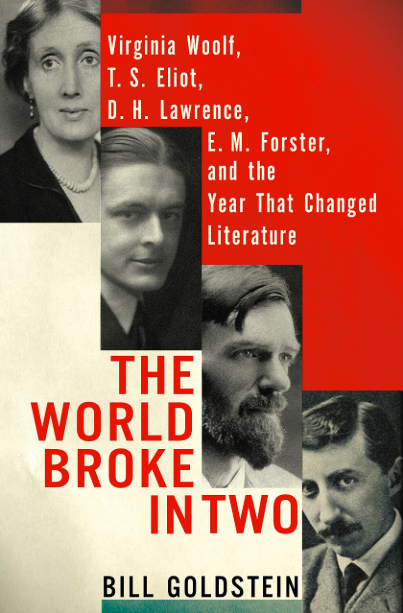
THE WORLD BROKE IN TWO

Bill Goldstein

Virginia Woolf, T. S. Eliot, D. H. Lawrence, E. M. Forster and the Year that Changed Literature

A revelatory narrative of the intersecting lives and works of revered authors Virginia Woolf, T. S. Eliot, E. M. Forster and D. H. Lawrence during 1922, the birth year of modernism.
The World Broke in Two tells the fascinating story of the intellectual and personal journeys four legendary writers, Virginia Woolf, T. S. Eliot, E. M. Forster, and D. H. Lawrence, make over the course of one pivotal year. As 1922 begins, all four are literally at a loss for words, confronting an uncertain creative future despite success in the past. The literary ground is shifting, as Ulysses is published in February and Proust’s In Search of Lost Time begins to be published in England in the autumn. Yet, dismal as their prospects seemed in January, by the end of the year Woolf has started Mrs. Dalloway, Forster has, for the first time in nearly a decade, returned to work on the novel that will become A Passage to India, Lawrence has written Kangaroo, his unjustly neglected and most autobiographical novel, and Eliot has finished - and published to acclaim - “The Waste Land."
As Willa Cather put it, “The world broke in two in 1922 or thereabouts,” and what these writers were struggling with that year was in fact the invention of modernism. Based on original research, Bill Goldstein's The World Broke in Two captures both the literary breakthroughs and the intense personal dramas of these beloved writers as they strive for greatness.

Bill Goldstein, the founding editor of the books site of The New York Times on the Web, reviews books and interviews authors for NBC's "Weekend Today in New York." He is also curator of public programs at Roosevelt House, the public policy institute of New York's Hunter College. He received a PH.D in English from City University of New York Graduate Center in 2010, and is the recipient of writing fellowships at MacDowell, Yaddo, Ucross and elsewhere.
Available products
Book

Published 2017-07-25 by Henry Holt and Company

Book

Published 2017-07-25 by Henry Holt and Company

Comments

The World Broke in Two is more fun to read than it has any right to be. Its subject - the overlapping neuroses, illnesses, and inspirations of four 20th Century greats - would seem familiar territory. But Goldstein is such a companionable writer and his narrative is so full of telling detail that we encounter each of these writers anew. The result is a book that anyone interested in the vicissitudes of the writing life - then or now - will read with hunger. Like all good accounts of writing, it draws us back to the books themselves.

Bill Goldstein, a wizard of words, has gifted us with a magical brew. Profoundly researched and filled with stunning connections, The World Broke in Two is brilliant, compelling, incisive. It transforms our understanding of modern literature, and the creative relationships of Virginia Woolf, T.S. Eliot, D.H. Lawrence, and E.M. Forster. Everyone interested in history, literature, life will enjoy and benefit from this dazzling work.

What a masterpiece this book is! So captivating, so original, so full of energy, insights and analysis! Bill Goldstein's brilliant work will be read with great pleasure not only by those who think they already know his famous subjects, but by all readers who love history and biography.

[An] accomplished, captivating look at that seminal year through the lens of the interconnecting lives of four literary icons...Impressively rich and nuanced...[Goldstein's] evenhanded passion for each of his subjects plays out in an elegant narrative. In our own fractured, impatient age, the poignant and arresting stories of these four genius writers evoke nostalgia for a time when precision and introspection were the guiding principles of literature. The World Broke in Two beautifully captures a seismic moment of cultural rupture that, despite its shock and awe, left something new and exciting in its path.

His main achievement is in his careful use of the private correspondence and diaries of four writers to navigate his way through the period . . . Goldstein has done tremendous and valid work here to find the small but crucial changes in these writers' lives that resulted in their various attempts to capture consciousness on the page.

Goldstein writes assuredly and well of the work of his chosen four exemplars; though Lawrence is barely read these days, the others still hold up, and he brings fresh eyes to all of them. An engaging, lightly worn literary study, of a piece with Hugh Kenner's The Pound Era (1971) in divining the origins of the modern.

The World Broke in Two chronicles Morgan (Forster), David (Lawrence), Tom (Eliot) and Virginia (Woolf) as they wage personal battle in tremendous earnest against blank sheets of paper to create important new works from the inner recesses of their genius. Goldstein offers a snapshot history of their careers in deference to the American now, embracing not only the chatty familiarity of first names but also, and more significant, the biographical details of authorship that most 21st-century interest in literature seems to depend upon.

This is a brilliant book about the birth of modernism, one which taught me something on every page. I never knew what a life-changing influence Proust had on Virginia Woolf and E.M. Forster—or how everyone struggled with money, especially T. S. Eliot. This beautifully written book reveals how artistic innovation occurs in the real world of gossip, love affairs, poverty and class differences. You will feel—and be!—much smarter after you read it.

An extensively researched, extraordinarily fine-grained and lucid literary history rich in biographical discoveries... Goldstein's ardently detailed, many-faceted story of a pivotal literary year illuminates all that these tormented visionaries had to overcome to 'make the modern happen.

The World Broke in Two is a gem of collective - and interwoven - biography. Like the great modernists of fiction, Bill Goldstein pays keen imaginative attention to simultaneity; he surveys the literary landscape, and these four great peaks upon it, as if he were the pilot flying that famous airplane over Mrs. Dalloway. The reader is made to see the writers - paused, burgeoning, and on the brink - in strong relationship to one another. The result is a view and vision we've not had before.

The year 1922 was indeed "a grrrreat littttterary period," as Ezra Pound wrote to T. S. Eliot, and as Bill Goldstein demonstrates in this stunningly written, riveting day-by-day account of how four of the world's most beloved writers created their greatest works. He provides new insight into the relationships among writers we thought we knew. How heartening this book will be to readers and to writers - it was to me - to realize that even Virginia Woolf, T. S. Eliot, E. M. Forster, and D. H. Lawrence experienced self-doubts, envy, and all kinds of other challenges, and that they simply had to plow through them and get their work done. The World Broke in Two brilliantly illuminates the adventure that is the creative process.