| Vendor | |
|---|---|

|
Mohrbooks Literary Agency
Sebastian Ritscher |
| Original language | |
| English | |
| Categories | |
| Weblink | |
| stevelevinebooks.com/the-powerho … | |
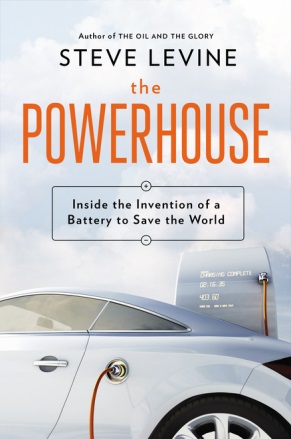
THE POWERHOUSE
Inside the Invention of a Battery to Save the World
THE GREAT BATTERY RACE by Steve LeVine is a compelling and surprisingly accessible look at the global race to build an efficient (not to mention practical and affordable) battery to power not only our greenhouse-gas-emitting automobiles, but also a new industrial age.
This isn’t just a book about batteries—it’s a book about the scientific and political implications of a crucial new technology—at stake is not just a healthier planet, but a new industrial leader. As evidenced by the attached article from The Atlantic, this is an issue with increasing presence in the public eye. And on March 31, 2014, the Intergovernmental Panel on Climate Change issued its most grim and sobering assessment on climate change yet. Surprisingly (or perhaps not), the humble battery, one the world’s most common household objects, has become central to the most important geopolitical and economic battle to date.
More or less simultaneously the United States, China, and virtually every other nation with an industrial base has concluded that powerful advanced batteries and the product that will chiefly use them – affordable, long-distance electric cars – will be the world’s next great engine of economic growth. At Argonne National Laboratory outside Chicago—to which author Steve LeVine was granted rare and unprecedented access—Jeff Chamberlain is driving a team of 52 scientists toward a breakthrough in one of the world’s most consequential and competitive fields of technology, a cutting-edge discovery that could determine who controls the crucial next generation of lithium-ion batteries.
The Great Battery Race follows Chamberlain’s group over the period of a year, relying on rare, full access to his top-secret laboratory, through emotional highs and deflating setbacks as it struggles to harness this technology. Combining molecular and material science; cutting-edge high-tech wheeling and dealing; and contentious geopolitics (Wan Gang, China’s charismatic minister of science, has made it clear that he intends his country to rule both the battery and electric car industries), the book traces the aspirations, stumbles, successes and frustrations of a small group of scientists working in a new, pivotal industry that, like desktop computing in the 1970s, is poised to create a technological revolution—and a new industrial power.
Steve LeVine is currently a Bernard L. Schwartz Fellow at the New America Foundation and Washington correspondent for Quartz, where he writes about the geopolitics of energy and technology. He is also an adjunct professor at Georgetown University's School of Foreign Service. He was previously a foreign correspondent for eighteen years in the former Soviet Union, Pakistan and the Philippines, for The Wall Street Journal, The New York Times, The Washington Post, the Financial Times and Newsweek. He formerly wrote “The Oil and the Glory,” a blog on energy and geopolitics at Foreign Policy magazine.
More or less simultaneously the United States, China, and virtually every other nation with an industrial base has concluded that powerful advanced batteries and the product that will chiefly use them – affordable, long-distance electric cars – will be the world’s next great engine of economic growth. At Argonne National Laboratory outside Chicago—to which author Steve LeVine was granted rare and unprecedented access—Jeff Chamberlain is driving a team of 52 scientists toward a breakthrough in one of the world’s most consequential and competitive fields of technology, a cutting-edge discovery that could determine who controls the crucial next generation of lithium-ion batteries.
The Great Battery Race follows Chamberlain’s group over the period of a year, relying on rare, full access to his top-secret laboratory, through emotional highs and deflating setbacks as it struggles to harness this technology. Combining molecular and material science; cutting-edge high-tech wheeling and dealing; and contentious geopolitics (Wan Gang, China’s charismatic minister of science, has made it clear that he intends his country to rule both the battery and electric car industries), the book traces the aspirations, stumbles, successes and frustrations of a small group of scientists working in a new, pivotal industry that, like desktop computing in the 1970s, is poised to create a technological revolution—and a new industrial power.
Steve LeVine is currently a Bernard L. Schwartz Fellow at the New America Foundation and Washington correspondent for Quartz, where he writes about the geopolitics of energy and technology. He is also an adjunct professor at Georgetown University's School of Foreign Service. He was previously a foreign correspondent for eighteen years in the former Soviet Union, Pakistan and the Philippines, for The Wall Street Journal, The New York Times, The Washington Post, the Financial Times and Newsweek. He formerly wrote “The Oil and the Glory,” a blog on energy and geopolitics at Foreign Policy magazine.
| Available products |
|---|
|
Book
Published 2015-02-01 by Viking |
|
Book
Published 2015-02-01 by Viking |