| Vendor | |
|---|---|

|
Mohrbooks Literary Agency
Sebastian Ritscher |
| Original language | |
| English | |
| Categories | |
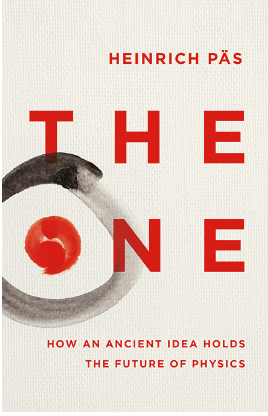
THE ONE
How an Ancient Idea Holds the Future of Physics
A particle physicist makes the scientific case for an ancient idea about the nature of the universe: that all is One .
"From all things One and from One all things," wrote the ancient Greek philosopher Heraclitus. You might read this as a platitude, or as a pleasant spiritual or philosophical idea. You probably wouldn't read it as a more-or-less accurate scientific statement about the nature of the universe. Particle physicist Heinrich Päs, however, does.
In The One, Päs makes the surprising and compelling case for monism - the philosophical idea that one single, all-encompassing thing underlies everything we experience - rehabilitating the idea's reputation and reclaiming it for science. At first glance, the idea that "all is one" seems patently absurd. But Päs reveals that monism follows logically from certain principles of quantum mechanics once they are applied to the entire universe. He shows how monism is not only a feasible theory from a scientific perspective but a potentially powerful solution to the stagnation of thought in contemporary physics, arguing that if physics is ever to progress, physicists must learn to embrace insights from outside the narrow silo of experimental knowledge. Along the way, Päs traces monism's often-buried 3000-year history, passing through the lives of a diverse array of great thinkers, including Plato, Galileo, Spinoza, and Goethe, and the churchmen, philosophers, and physicists who fought against monism as well. The result is an epic and expansive journey through thousands of years of human thought and into the nature of reality itself.
Equal parts physics, philosophy, and history of ideas, The One is of the rare sort of book that can both the first-time reader with its marvels and revolutionize the worldview of even the most experienced physics buff.
Heinrich Päs is a professor of theoretical physics at the Technical University of Dortmund in Germany. He earned his PhD from the University of Heidelberg for research at the Max- Planck-Institut, has held positions at Vanderbilt University and the University of Alabama and has conducted research visits at CERN, Fermilab, the Gran Sasso Laboratory, and more. Päs has written a Scientific American cover feature, and his research was featured three times on the cover of New Scientist. He lives in Bremen, Germany.
In The One, Päs makes the surprising and compelling case for monism - the philosophical idea that one single, all-encompassing thing underlies everything we experience - rehabilitating the idea's reputation and reclaiming it for science. At first glance, the idea that "all is one" seems patently absurd. But Päs reveals that monism follows logically from certain principles of quantum mechanics once they are applied to the entire universe. He shows how monism is not only a feasible theory from a scientific perspective but a potentially powerful solution to the stagnation of thought in contemporary physics, arguing that if physics is ever to progress, physicists must learn to embrace insights from outside the narrow silo of experimental knowledge. Along the way, Päs traces monism's often-buried 3000-year history, passing through the lives of a diverse array of great thinkers, including Plato, Galileo, Spinoza, and Goethe, and the churchmen, philosophers, and physicists who fought against monism as well. The result is an epic and expansive journey through thousands of years of human thought and into the nature of reality itself.
Equal parts physics, philosophy, and history of ideas, The One is of the rare sort of book that can both the first-time reader with its marvels and revolutionize the worldview of even the most experienced physics buff.
Heinrich Päs is a professor of theoretical physics at the Technical University of Dortmund in Germany. He earned his PhD from the University of Heidelberg for research at the Max- Planck-Institut, has held positions at Vanderbilt University and the University of Alabama and has conducted research visits at CERN, Fermilab, the Gran Sasso Laboratory, and more. Päs has written a Scientific American cover feature, and his research was featured three times on the cover of New Scientist. He lives in Bremen, Germany.
| Available products |
|---|
|
Book
Published 2023-01-10 by Basic Books |
|
Book
Published 2023-01-10 by Basic Books |