| Vendor | |
|---|---|

|
Mohrbooks Literary Agency
Sebastian Ritscher |
| Original language | |
| English | |
| Categories | |
| Weblink | |
| https://www.chrisbegley.com | |
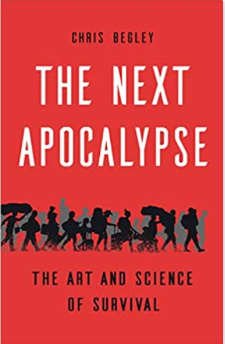
THE NEXT APOCALYPSE
The Art and Science of Survival
Why understanding how ancient civilizations end can help us prepare for a potentially disastrous future
In an age of pandemics, climate change, and political unrest, you don't have to be a prepper to worry about the future or to wonder how to prepare for it. Many of us conjure up images of a post-apocalyptic world where life is simple, our needs and goals clear. We imagine a desolate, barren world, where starting fires, hunting, and building shelter are our most valuable skills. But as archeologist, anthropologist, and survival instructor Chris Begley argues, an apocalyptic disaster will look nothing like our fantasies, and if we want to prepare for it, then we must look to history.
Drawing on three decades of archeological and anthropological research on civilizations as diverse as the Maya, the Roman Empire, and Angkor Watt, Begley shows that apocalypses don't happen in a flash, they happen slowly, and they hardly ever result in the disappearance of an entire population. The collapse of the Mayan civilization in the thirteenth century is a case in point. Though the Maya left behind a great many vacated cities and complexes, the people survived. There are still five million Maya alive today. Overpopulation and drought, followed by famine and warfare, drove the Maya away from once-flourishing cities. Such migration is one of the hallmarks of the apocalypse that Begley envisions. He details the scenarios that could lead to mass migration, from climate change and disease to war and political collapse, and how we might prepare for them. Planning for disaster isn't simply about learning how to find food and water or to start a fire. First and foremost, we'll need to learn how to navigate the complex social and political dynamics that will inevitably emerge as migration, food shortages, and war bring out our most primal instincts. Rather than viewing people on the move as potential looters and trying to protect our own stockpiles, we'll need to see them as people in need, who might possess skills that are useful to us all. The ultimate test of our survival won't be whether we can adjust to a world without technology or other modern conveniences. It will be how we respond to the loss of culture and sense of common humanity that give our lives purpose and meaning. If we want to survive, the thing to do isn't to run to our hideouts; it's to rebuild our communal bonds. And that begins with helping others.
Combining the experiences, insights, and acumen of an adventurer with the scholarly perspectives of an archeologist and anthropologist, Begley transforms our understanding of the fall of civilizations and challenges us to build a future rooted in empathy, humanity, and a commitment to the common good.
Chris Begley is the Director of The Exploration Foundation and a professor of Anthropology at Transylvania University. His research focuses on issues of ethnicity and identity among ancient populations in the remote jungles of the Mosquito Coast of Honduras. He is also a survival coach with two decades of experience leading tourist groups through Central America, Peru, Guyana, Suriname, and Albania. He lives in Lexington, Kentucky.
Drawing on three decades of archeological and anthropological research on civilizations as diverse as the Maya, the Roman Empire, and Angkor Watt, Begley shows that apocalypses don't happen in a flash, they happen slowly, and they hardly ever result in the disappearance of an entire population. The collapse of the Mayan civilization in the thirteenth century is a case in point. Though the Maya left behind a great many vacated cities and complexes, the people survived. There are still five million Maya alive today. Overpopulation and drought, followed by famine and warfare, drove the Maya away from once-flourishing cities. Such migration is one of the hallmarks of the apocalypse that Begley envisions. He details the scenarios that could lead to mass migration, from climate change and disease to war and political collapse, and how we might prepare for them. Planning for disaster isn't simply about learning how to find food and water or to start a fire. First and foremost, we'll need to learn how to navigate the complex social and political dynamics that will inevitably emerge as migration, food shortages, and war bring out our most primal instincts. Rather than viewing people on the move as potential looters and trying to protect our own stockpiles, we'll need to see them as people in need, who might possess skills that are useful to us all. The ultimate test of our survival won't be whether we can adjust to a world without technology or other modern conveniences. It will be how we respond to the loss of culture and sense of common humanity that give our lives purpose and meaning. If we want to survive, the thing to do isn't to run to our hideouts; it's to rebuild our communal bonds. And that begins with helping others.
Combining the experiences, insights, and acumen of an adventurer with the scholarly perspectives of an archeologist and anthropologist, Begley transforms our understanding of the fall of civilizations and challenges us to build a future rooted in empathy, humanity, and a commitment to the common good.
Chris Begley is the Director of The Exploration Foundation and a professor of Anthropology at Transylvania University. His research focuses on issues of ethnicity and identity among ancient populations in the remote jungles of the Mosquito Coast of Honduras. He is also a survival coach with two decades of experience leading tourist groups through Central America, Peru, Guyana, Suriname, and Albania. He lives in Lexington, Kentucky.
| Available products |
|---|
|
Book
Published 2021-11-16 by Basic Books |