| Vendor | |
|---|---|

|
Liepman Literary Agency
Marc Koralnik |
| Original language | |
| English | |
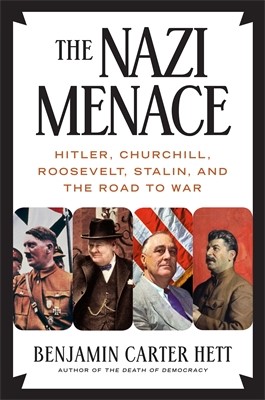
THE NAZI MENACE
Hitler, Churchill, Roosevelt, Stalin, and the Road to War
Berlin, November 1937. In a secret meeting with his top advisors, Adolf Hitler proclaims the urgent necessity for a war of aggression in Europe. Some conservatives are unnerved by this grandiose plan, but they are soon silenced, setting in motion events that will lead to the most calamitous war in history.
Benjamin Carter Hett, the author of The Death of Democracy, his acclaimed history of the fall of the Weimar Republic, takes us from Berlin to London, Moscow, and Washington to show how anti-Nazi forces inside and outside Germany came to understand Hitler's true menace to European civilization and learned to oppose him. Drawing on original sources in German, English, French, and Russian, including newly released intelligence documents, he paints a sweeping portrait of governments under siege, populated by larger-than-life figures like Winston Churchill, Joseph Stalin, Neville Chamberlain, Franklin Roosevelt, Joachim von Ribbentrop, and Vyacheslav Molotov.
The Nazi Menace evokes a time when the verities of life were subverted, a time marked by fake news, cultural unrest over refugees, and the challenges of national security in a consumerist democracy. To read Hett's book is to see the 1930sand our world todayin a new and unnerving light.
Rights previously sold for The Death of Democracy: UK / Heinemann, Canada / Allen Lane, Arabic/Fawasel, Chinese (simplified)/Shanghai Elegance, Dutch/Balans, Finnish/WSOY, Greek/Dioptra, Italian/ Einaudi; Portuguese (in Brazil)/Editora Globo, Romanian/Polirom, Spanish/Planeta Mexico, Turkish/Profil Yayinlari, Vietnamese/Phan Books
Press for The Death of Democracy:
Named "Book of the Week" by CNN's Fareed Zakaria GPS
Named a Best Book of the Year by The Daily Telegraph (UK) and The Times of London
[An] extremely fine study of the end of constitutional rule in Germany. . . . With careful prose and fine scholarship, with fine thumbnail sketches of individuals and concise discussions of institutions and economics, . . . [Benjamin Carter Hett] sensitively describes a moral crisis that preceded a moral catastrophe. -- Timothy Snyder, The New York Times Book Review (Editor's Choice)
"At a time of deep distress over the stability of democracy in America and elsewhere, Benjamin Carter Hett's chronicle of the collapse of the Weimar Republic and the rise of Adolf Hitler could not be more timely. 'The Death of Democracy' makes for chilling reading." -- Roger Lowenstein, The Washington Post
"If this is an oft-told and tragic tale, Hett's brisk and lucid study offers compelling new perspectives inspired by current threats to free societies around the world. . . . It is both eerie and enlightening how much of Hett's account rings true in our time." -- E. J. Dionne Jr., The Washington Post
Particularly instructive. . . . a penetrating study of how Nazism overtook the Weimar Republic. Hett never mentions Trump; the societal parallels are, of course, far from exact. But his account carries a troubling ? and clearly intentional ? resonance. -- Richard North Patterson, Huffington Post
With a wealth of telling detail, a keen eye for human character, and a talent for gripping narrative, Benjamin Hett analyses the end of the Weimar Republic and the inauguration of the Nazi regime. It is a chilling and warning tale, for he shows that Hitler's victory was by no means inevitable. Rather, it was the result of human folly, greed, selfishness and, on the part of those who invited him, an unwillingness to confront the true meaning of Nazism and a willful insistence that they could use Hitler. Margaret MacMillan, author of The War That Ended Peace: The Road To 1914
"Intelligent, well-informed... intriguing. Hett provides a lesson about the fragility of democracy and the danger of that complacent belief that liberal institutions will always protect us." -- The Times (London)
Fascinating. . . . Readable and well-researched. -- Nicholas Shakespeare, The Daily Telegraph
"Intelligently written. . . . a fast-paced narrative enlivened by vignette and character sketches. . . . Hett reminds us that violence was at [fascism's] core. But he also insists that Hitler did not prevail because Weimar was doing badly. On the contrary, it was doing remarkably well in tough conditions: the end came because conservative elites thought they could use the Nazis for their own purposes and realised their mistake too late." -- Mark Mazower, Financial Times
"Hett also reminds us that Hitler was deliberately enabled by conservative elites, especially business leaders and military commanders, who wanted the electoral votes of the Nazi movement and were willing to overlook its excesses to achieve their goals. . . . Hitler was also enabled by a disaffected public increasingly prone to aggressive myth-making and irrationality.' . . . At no point does Hett mention any current political figure by name, but his warning is nonetheless loud, clear, and urgent. -- Booklist
How did Adolf Hitler, an obvious extremist, con a nation into backing him? This historical essay answers the question, to often unsettling effect. . . . A provocative, urgent history with significant lessons for today. -- Kirkus Reviews
"Persuasively challenges familiar arguments that the rise of Nazi Germany was an inevitable consequence of abstract forces. . . [A] page-turning account."--Publishers Weekly
A brilliant account of the twentieth century's great political catastrophe: the Nazi capture of power. Full of arresting images and ideas, this gripping new book charts the rise and fall of the first German republic, and the unlikely victory of Adolf Hitler. A timely reminder of the fragility of democracy and the dangers of extreme nationalism.--Nikolaus Wachsmann, author of KL: A History of the Nazi Concentration Camps
The story of how Germany turned from democracy to dictatorship in the fifteen years following World War I is not a simple one. But the moral lessons are exceptionally clear. Benjamin Carter Hett honors that complexity in this account while never straying from the path of moral clarity. An outstanding accomplishment.--Rick Perlstein, author of Nixonland and The Invisible Bridge
Benjamin Carter Hett is one of the few historians who is able to think out of the box and knows how to tell a story well without simplifying it. His new book tackles one of the most interesting questions in German history: How was it possible that an educated and developed country like Germany could fall for Adolf Hitler?
--Stefan Aust, editor of Die Welt, former editor of Der Spiegel, and author of The Baader-Meinhof Complex
The Death of Democracy is a thought-provoking new look at the collapse of German democracy in 1930-34 with a clear and careful emphasis on those individuals who operated behind the scenes to bring Hitler to power. Benjamin Carter Hett also offers insight into the steps Hitler took to consolidate his power.
--Gerhard L. Weinberg, professor emeritus of history, University of North Carolina
Histories of Nazi Germany can be overwhelming. The Death of Democracy is carefully focused on the conditions and cynical choices that enabled Nazism, in just a few years turning one of the world's most advanced and liberal societies into a monstrosity. Its author is also that rarity, a specialist who writes lucidly and engagingly. In this post-truth, alternative-facts American moment, The Death of Democracy is essential reading. --Kurt Andersen, author of Fantasyland: How America Went Haywire, A 500-Year History
Benjamin Carter Hett is the author of The Death of Democracy, Burning the Reichstag, Crossing Hitler, and Death in the Tiergarten. He is a professor of history at Hunter College and the Graduate Center of the City University of New York, and holds a PhD in history from Harvard University and a law degree from the University of Toronto. Born in Rochester, New York, he grew up in Edmonton, Alberta, and now lives in New York City.
Benjamin Carter Hett, the author of The Death of Democracy, his acclaimed history of the fall of the Weimar Republic, takes us from Berlin to London, Moscow, and Washington to show how anti-Nazi forces inside and outside Germany came to understand Hitler's true menace to European civilization and learned to oppose him. Drawing on original sources in German, English, French, and Russian, including newly released intelligence documents, he paints a sweeping portrait of governments under siege, populated by larger-than-life figures like Winston Churchill, Joseph Stalin, Neville Chamberlain, Franklin Roosevelt, Joachim von Ribbentrop, and Vyacheslav Molotov.
The Nazi Menace evokes a time when the verities of life were subverted, a time marked by fake news, cultural unrest over refugees, and the challenges of national security in a consumerist democracy. To read Hett's book is to see the 1930sand our world todayin a new and unnerving light.
Rights previously sold for The Death of Democracy: UK / Heinemann, Canada / Allen Lane, Arabic/Fawasel, Chinese (simplified)/Shanghai Elegance, Dutch/Balans, Finnish/WSOY, Greek/Dioptra, Italian/ Einaudi; Portuguese (in Brazil)/Editora Globo, Romanian/Polirom, Spanish/Planeta Mexico, Turkish/Profil Yayinlari, Vietnamese/Phan Books
Press for The Death of Democracy:
Named "Book of the Week" by CNN's Fareed Zakaria GPS
Named a Best Book of the Year by The Daily Telegraph (UK) and The Times of London
[An] extremely fine study of the end of constitutional rule in Germany. . . . With careful prose and fine scholarship, with fine thumbnail sketches of individuals and concise discussions of institutions and economics, . . . [Benjamin Carter Hett] sensitively describes a moral crisis that preceded a moral catastrophe. -- Timothy Snyder, The New York Times Book Review (Editor's Choice)
"At a time of deep distress over the stability of democracy in America and elsewhere, Benjamin Carter Hett's chronicle of the collapse of the Weimar Republic and the rise of Adolf Hitler could not be more timely. 'The Death of Democracy' makes for chilling reading." -- Roger Lowenstein, The Washington Post
"If this is an oft-told and tragic tale, Hett's brisk and lucid study offers compelling new perspectives inspired by current threats to free societies around the world. . . . It is both eerie and enlightening how much of Hett's account rings true in our time." -- E. J. Dionne Jr., The Washington Post
Particularly instructive. . . . a penetrating study of how Nazism overtook the Weimar Republic. Hett never mentions Trump; the societal parallels are, of course, far from exact. But his account carries a troubling ? and clearly intentional ? resonance. -- Richard North Patterson, Huffington Post
With a wealth of telling detail, a keen eye for human character, and a talent for gripping narrative, Benjamin Hett analyses the end of the Weimar Republic and the inauguration of the Nazi regime. It is a chilling and warning tale, for he shows that Hitler's victory was by no means inevitable. Rather, it was the result of human folly, greed, selfishness and, on the part of those who invited him, an unwillingness to confront the true meaning of Nazism and a willful insistence that they could use Hitler. Margaret MacMillan, author of The War That Ended Peace: The Road To 1914
"Intelligent, well-informed... intriguing. Hett provides a lesson about the fragility of democracy and the danger of that complacent belief that liberal institutions will always protect us." -- The Times (London)
Fascinating. . . . Readable and well-researched. -- Nicholas Shakespeare, The Daily Telegraph
"Intelligently written. . . . a fast-paced narrative enlivened by vignette and character sketches. . . . Hett reminds us that violence was at [fascism's] core. But he also insists that Hitler did not prevail because Weimar was doing badly. On the contrary, it was doing remarkably well in tough conditions: the end came because conservative elites thought they could use the Nazis for their own purposes and realised their mistake too late." -- Mark Mazower, Financial Times
"Hett also reminds us that Hitler was deliberately enabled by conservative elites, especially business leaders and military commanders, who wanted the electoral votes of the Nazi movement and were willing to overlook its excesses to achieve their goals. . . . Hitler was also enabled by a disaffected public increasingly prone to aggressive myth-making and irrationality.' . . . At no point does Hett mention any current political figure by name, but his warning is nonetheless loud, clear, and urgent. -- Booklist
How did Adolf Hitler, an obvious extremist, con a nation into backing him? This historical essay answers the question, to often unsettling effect. . . . A provocative, urgent history with significant lessons for today. -- Kirkus Reviews
"Persuasively challenges familiar arguments that the rise of Nazi Germany was an inevitable consequence of abstract forces. . . [A] page-turning account."--Publishers Weekly
A brilliant account of the twentieth century's great political catastrophe: the Nazi capture of power. Full of arresting images and ideas, this gripping new book charts the rise and fall of the first German republic, and the unlikely victory of Adolf Hitler. A timely reminder of the fragility of democracy and the dangers of extreme nationalism.--Nikolaus Wachsmann, author of KL: A History of the Nazi Concentration Camps
The story of how Germany turned from democracy to dictatorship in the fifteen years following World War I is not a simple one. But the moral lessons are exceptionally clear. Benjamin Carter Hett honors that complexity in this account while never straying from the path of moral clarity. An outstanding accomplishment.--Rick Perlstein, author of Nixonland and The Invisible Bridge
Benjamin Carter Hett is one of the few historians who is able to think out of the box and knows how to tell a story well without simplifying it. His new book tackles one of the most interesting questions in German history: How was it possible that an educated and developed country like Germany could fall for Adolf Hitler?
--Stefan Aust, editor of Die Welt, former editor of Der Spiegel, and author of The Baader-Meinhof Complex
The Death of Democracy is a thought-provoking new look at the collapse of German democracy in 1930-34 with a clear and careful emphasis on those individuals who operated behind the scenes to bring Hitler to power. Benjamin Carter Hett also offers insight into the steps Hitler took to consolidate his power.
--Gerhard L. Weinberg, professor emeritus of history, University of North Carolina
Histories of Nazi Germany can be overwhelming. The Death of Democracy is carefully focused on the conditions and cynical choices that enabled Nazism, in just a few years turning one of the world's most advanced and liberal societies into a monstrosity. Its author is also that rarity, a specialist who writes lucidly and engagingly. In this post-truth, alternative-facts American moment, The Death of Democracy is essential reading. --Kurt Andersen, author of Fantasyland: How America Went Haywire, A 500-Year History
Benjamin Carter Hett is the author of The Death of Democracy, Burning the Reichstag, Crossing Hitler, and Death in the Tiergarten. He is a professor of history at Hunter College and the Graduate Center of the City University of New York, and holds a PhD in history from Harvard University and a law degree from the University of Toronto. Born in Rochester, New York, he grew up in Edmonton, Alberta, and now lives in New York City.
| Available products |
|---|
|
Book
Published 2020-08-01 by Henry Holt |