| Vendor | |
|---|---|

|
Liepman Literary Agency
Marc Koralnik |
| Original language | |
| English | |
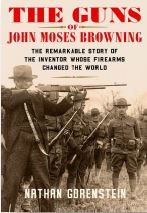
THE GUNS OF JOHN MOSES BROWNING
The Remarkable Story of the Inventor Whose Firearms Changed the World
"Thomas Edison. Henry Ford. The Wright brothers. All are household names. Missing from that list is John Moses Browning. He is the 19th century mechanical genius whose inventions for good or ill were used to start World War I, win World War II and arm soldiers across the globe. The Master and His Machines will show we live in a world Browning helped create."
THE GUNS OF JOHN MOSES BROWNING is an absolutely fascinating biography, vividly telling the complex and little-known story of this great inventor (who could visualize the most complex of mechanisms and then build a working prototype from that created image in his brain, never using a blueprint, but moving, as he put it "from mind to metal"). But beyond that, the book also presents a sweeping and highly relevant history of the 20th century, told through the decisive influence Browning's machines had on world scale events and how technological and political issues fundamental to our own times still reflect the impact and reach of his genius and the forces he unleashed. Amazingly there has not been a major biography of Browning, but only a volume written long ago by his brother.
Browning, a son of the frontier with a rudimentary education, was raised in Ogden, Utah by his gunsmith father. In 1879, Browning designed a single shot rifle and went on from there to be the premier firearms inventor of his era and beyond, eventually holding 126 patents and devising innovative pistols, rifles, shotguns and machine guns. World War II was basically won with Browning weapons, used by every US squad, platoon, company and battalion and mounted on fighters, bombers, ships and tanks. But his military designs, many still in use today, were a fraction of his total design output. His guns so thoroughly dominated the international civilian firearms market, that they enabled an aggressive transition from subsistence hunting to sport hunting (six million units of his Model 1894 hunting rifle were sold). Browning's A5, which fired 5 rounds within seconds, was so devastating to wildlife, many localities imposed a 3-cartridge limit. And logically, the gun control movement went beyond hunting. Inspired by the number of Browning pistols circulating in the first decade of the 20th century, which raised the murder rate so substantially, many jurisdictions established local handgun registration and sales laws. One German official mourned the change from "the culture of the knife to the culture of the gun," signifying that a line had been permanently crossed. This is not a pro-gun or anti-gun book. Actually, although it contains absorbing detail about gun design and manufacture, it is not really a book primarily about guns themselves or whether they are bad or good, but an exploration of the profound, often contradictory, always provocative social and cultural impact that Browning's work has had on modern life and will continue to have for the foreseeable future. As the author writes, "As we live in Edison's world of light and sound and Ford's world of cars and the Wright Brothers' world of airplanes, so we live in the world Browning's weapons created and sometimes destroyed. His guns were the implement of history."
THE GUNS OF JOHN MOSES BROWNING will synthesize archival material, corporate records, contemporaneous newspaper and magazine accounts, government documents and first-hand combat reports to create a multi-dimensional narrative portrait of Browning and his seminal work, which took him all across America and to Europe. This is a book for readers of biographies of transformational figures and also works by authors such as Jared Diamond that examine the often surprising curve of history from unique perspectives. The author, Nathan Gorenstein, is a former investigative reporter, editor and editorial board member at The Philadelphia Inquirer, where he worked for 24 years. During the course of his writing career Gorenstein regularly produced groundbreaking work (see the proposal for full details).
Browning, a son of the frontier with a rudimentary education, was raised in Ogden, Utah by his gunsmith father. In 1879, Browning designed a single shot rifle and went on from there to be the premier firearms inventor of his era and beyond, eventually holding 126 patents and devising innovative pistols, rifles, shotguns and machine guns. World War II was basically won with Browning weapons, used by every US squad, platoon, company and battalion and mounted on fighters, bombers, ships and tanks. But his military designs, many still in use today, were a fraction of his total design output. His guns so thoroughly dominated the international civilian firearms market, that they enabled an aggressive transition from subsistence hunting to sport hunting (six million units of his Model 1894 hunting rifle were sold). Browning's A5, which fired 5 rounds within seconds, was so devastating to wildlife, many localities imposed a 3-cartridge limit. And logically, the gun control movement went beyond hunting. Inspired by the number of Browning pistols circulating in the first decade of the 20th century, which raised the murder rate so substantially, many jurisdictions established local handgun registration and sales laws. One German official mourned the change from "the culture of the knife to the culture of the gun," signifying that a line had been permanently crossed. This is not a pro-gun or anti-gun book. Actually, although it contains absorbing detail about gun design and manufacture, it is not really a book primarily about guns themselves or whether they are bad or good, but an exploration of the profound, often contradictory, always provocative social and cultural impact that Browning's work has had on modern life and will continue to have for the foreseeable future. As the author writes, "As we live in Edison's world of light and sound and Ford's world of cars and the Wright Brothers' world of airplanes, so we live in the world Browning's weapons created and sometimes destroyed. His guns were the implement of history."
THE GUNS OF JOHN MOSES BROWNING will synthesize archival material, corporate records, contemporaneous newspaper and magazine accounts, government documents and first-hand combat reports to create a multi-dimensional narrative portrait of Browning and his seminal work, which took him all across America and to Europe. This is a book for readers of biographies of transformational figures and also works by authors such as Jared Diamond that examine the often surprising curve of history from unique perspectives. The author, Nathan Gorenstein, is a former investigative reporter, editor and editorial board member at The Philadelphia Inquirer, where he worked for 24 years. During the course of his writing career Gorenstein regularly produced groundbreaking work (see the proposal for full details).
| Available products |
|---|
|
Book
Published 2023-05-11 by Scribner |