| Vendor | |
|---|---|

|
Mohrbooks Literary Agency
Sebastian Ritscher |
| Original language | |
| English | |
| Categories | |
| Weblink | |
| http://www.penguinrandomhouse.co … | |
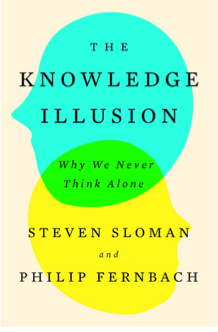
THE KNOWLEDGE ILLUSION
Why We Never Think Alone
The key to human intelligence lies in the fascinating ways we think together.
Humans have built hugely complex societies and technologies, but most of us don’t even know how a pen works. So how have we achieved so much despite understanding so little? Cognitive scientists Steven Sloman and Philip Fernbach argue that we survive and thrive despite our mental shortcomings because we live in a rich community of knowledge. We’re constantly drawing on information and expertise stored outside our heads: in our bodies, our environment, our possessions, and the people with whom we interact—and usually we don’t even realize we’re doing it.
The human mind is both brilliant and pathetic. We have mastered fire, created democratic institutions, stood on the moon, and developed genetically modified tomatoes. And yet each of us is error prone, sometimes irrational, and often ignorant. The fundamentally communal nature of intelligence and knowledge explains why we often assume we know more than we really do, why political opinions and false beliefs are so hard to change, and why individually oriented approaches to education and management frequently fail. But our collaborative minds also enable us to do amazing things. This book contends that true genius can be found in the ways we create intelligence using the world around us.
Steven Sloman is a Professor of Cognitive, Linguistic, and Psychological Sciences at Brown University where he has worked since 1992. His work concerns higher-order aspects of cognition, including causal reasoning, judgment and decision making, and categorization. He is currently Editor-in-Chief of the journal Cognition.
Phil Fernbach is a cognitive scientist and professor of marketing at the University of Colorado at Boulder. He focusses on how cognitive science can shed light on issues of critical importance to society, such as political polarization, acceptance of cutting edge technologies like genetic engineering, and consumer financial decision making. He has written for publications such as The New York Times, The Wall Street Journal, and BBC World News.
The human mind is both brilliant and pathetic. We have mastered fire, created democratic institutions, stood on the moon, and developed genetically modified tomatoes. And yet each of us is error prone, sometimes irrational, and often ignorant. The fundamentally communal nature of intelligence and knowledge explains why we often assume we know more than we really do, why political opinions and false beliefs are so hard to change, and why individually oriented approaches to education and management frequently fail. But our collaborative minds also enable us to do amazing things. This book contends that true genius can be found in the ways we create intelligence using the world around us.
Steven Sloman is a Professor of Cognitive, Linguistic, and Psychological Sciences at Brown University where he has worked since 1992. His work concerns higher-order aspects of cognition, including causal reasoning, judgment and decision making, and categorization. He is currently Editor-in-Chief of the journal Cognition.
Phil Fernbach is a cognitive scientist and professor of marketing at the University of Colorado at Boulder. He focusses on how cognitive science can shed light on issues of critical importance to society, such as political polarization, acceptance of cutting edge technologies like genetic engineering, and consumer financial decision making. He has written for publications such as The New York Times, The Wall Street Journal, and BBC World News.
| Available products |
|---|
|
Book
Published 2017-03-14 by Riverhead |
|
Book
Published 2017-03-14 by Riverhead |