| Vendor | |
|---|---|

|
Mohrbooks Literary Agency
Sebastian Ritscher |
| Original language | |
| English | |
| Categories | |
| Weblink | |
| erikachristakis.com | |
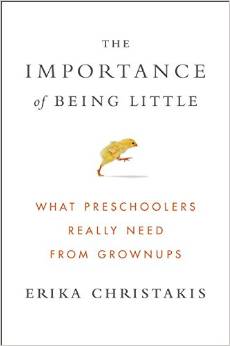
THE IMPORTANCE OF BEING LITTLE
What Preschoolers Really Need from Grownups
A bold challenge to the conventional wisdom about early childhood, with a pragmatic program to encourage parents and teachers to rethink how and where young children learn best by taking the child’s eye view of the learning environment.
Parents of young children today are embattled: Pick the “wrong” preschool and your child won’t get into the “right” college. But our fears are misplaced, according to Yale early childhood expert Erika Christakis. Children are powerful and inventive; and the tools to reimagine their learning environment are right in front of our eyes.
Children are hardwired to learn in any setting, but they don’t get the support they need when “learning” is defined by strict lessons and dodgy metrics that devalue children’s intelligence while placing unfit requirements on their developing brains. We have confused schooling with learning, and we have altered the very habitat young children occupy. The race for successful outcomes has blinded us to how young children actually process the world, acquire skills, and grow, says Christakis, who powerfully defends the preschool years as a life stage of inherent value and not merely as preparation for a demanding or uncertain future.
In her pathbreaking book, Christakis explores what it’s like to be a young child in America today, in a world designed by and for adults. With school-testing mandates run amok, playfulness squeezed, and young children increasingly pathologized for old-fashioned behaviors like daydreaming and clumsiness, it’s easy to miss what’s important about the crucial years of three to six, and the kind of guidance preschoolers really need. Christakis provides a forensic and far-reaching analysis of today’s whole system of early learning, exploring pedagogy, history, science, policy, and politics. She also offers a wealth of proven strategies about what to do to reimagine the learning environment to suit the child’s real, but often invisible, needs. The ideas range from accommodating children’s sense of time, to decluttering classrooms, to learning how to better observe and listen as children express themselves in pictures and words.
With her strong foundation in the study of child development and early education and her own in-the-trenches classroom experience, Christakis peels back the mystery of early childhood, revealing a place that’s rich with possibility. Her message is energizing and reassuring: Parents have more power (and more knowledge) than they think they do, and young children are inherently creative and will flourish, if we can learn new ways to support them and restore their vital learning habitat.
Erika Christakis is a Lecturer in early childhood education at Yale University’s esteemed Child Study Center, where she teaches undergraduate courses on childhood and education policy. An honors graduate of Harvard College, she has a MPH from Johns Hopkins; an MA in communication from the Annenberg School (University of Pennsylvania); and an MEd. in early childhood education, and is a Massachusetts-certified early childhood teacher (pre-K through 2nd grade) and licensed preschool director. She wrote a TIME.com “Ideas” column for two years and her work on children and families has appeared in numerous outlets, including CNN.com, the Washington Post, the Boston Globe, the Huffington Post and ABC’s Nightline.
Children are hardwired to learn in any setting, but they don’t get the support they need when “learning” is defined by strict lessons and dodgy metrics that devalue children’s intelligence while placing unfit requirements on their developing brains. We have confused schooling with learning, and we have altered the very habitat young children occupy. The race for successful outcomes has blinded us to how young children actually process the world, acquire skills, and grow, says Christakis, who powerfully defends the preschool years as a life stage of inherent value and not merely as preparation for a demanding or uncertain future.
In her pathbreaking book, Christakis explores what it’s like to be a young child in America today, in a world designed by and for adults. With school-testing mandates run amok, playfulness squeezed, and young children increasingly pathologized for old-fashioned behaviors like daydreaming and clumsiness, it’s easy to miss what’s important about the crucial years of three to six, and the kind of guidance preschoolers really need. Christakis provides a forensic and far-reaching analysis of today’s whole system of early learning, exploring pedagogy, history, science, policy, and politics. She also offers a wealth of proven strategies about what to do to reimagine the learning environment to suit the child’s real, but often invisible, needs. The ideas range from accommodating children’s sense of time, to decluttering classrooms, to learning how to better observe and listen as children express themselves in pictures and words.
With her strong foundation in the study of child development and early education and her own in-the-trenches classroom experience, Christakis peels back the mystery of early childhood, revealing a place that’s rich with possibility. Her message is energizing and reassuring: Parents have more power (and more knowledge) than they think they do, and young children are inherently creative and will flourish, if we can learn new ways to support them and restore their vital learning habitat.
Erika Christakis is a Lecturer in early childhood education at Yale University’s esteemed Child Study Center, where she teaches undergraduate courses on childhood and education policy. An honors graduate of Harvard College, she has a MPH from Johns Hopkins; an MA in communication from the Annenberg School (University of Pennsylvania); and an MEd. in early childhood education, and is a Massachusetts-certified early childhood teacher (pre-K through 2nd grade) and licensed preschool director. She wrote a TIME.com “Ideas” column for two years and her work on children and families has appeared in numerous outlets, including CNN.com, the Washington Post, the Boston Globe, the Huffington Post and ABC’s Nightline.
| Available products |
|---|
|
Book
Published 2016-02-09 by Viking |
|
Book
Published 2016-02-09 by Viking |