| Vendor | |
|---|---|

|
Mohrbooks Literary Agency
Sebastian Ritscher |
| Original language | |
| English | |
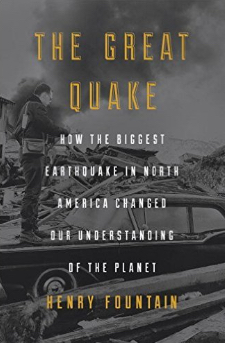
THE GREAT QUAKE
How the Biggest Earthquake in North America Changed our Understanding of the Planet
In the tradition of Erik Larson's Isaac's Storm, a riveting narrative about the biggest earthquake in recorded history in North America--the 1964 Alaskan earthquake that demolished the city of Valdez and obliterated the coastal village of Chenega--and the scientist sent to look for geological clues to explain the dynamics of earthquakes, who helped to confirm the then controversial theory of plate tectonics.
For many people, whether they live in a quake zone or not, earthquakes are a source of fascination and terror. Until 1964, there was a battle within the seismology community about what actually caused the earth to shake, roll, and split. Fountain’s narrative takes us not only inside the Alaskan towns that were devastated by the quake, but also inside the science community that finally agreed in the theory of plate tectonics.
On March 27, 1964, at 5:36 p.m., the biggest earthquake ever recorded in North America--and the second biggest ever in the world, measuring 9.2 on the Richter scale--struck Alaska, devastating coastal towns and villages and killing more than 130 people in what was then a relatively sparsely populated region. In a riveting tale about the almost unimaginable brute force of nature, New York Times science journalist Henry Fountain, in his first trade book, re-creates the lives of the villagers and townspeople living in Chenega, Anchorage, and Valdez; describes the sheer beauty of the geology of the region, with its towering peaks and 20-mile-long glaciers; and reveals the impact of the quake on the towns, the buildings, and the lives of the inhabitants. George Plafker, a geologist for the U.S. Geological Survey with years of experience scouring the Alaskan wilderness, is asked to investigate the Prince William Sound region in the aftermath of the quake, to better understand its origins. His work confirmed the then controversial theory of plate tectonics that explained how and why such deadly quakes occur, and how we can plan for the next one.
HENRY FOUNTAIN has been a reporter and editor at the New York Times for two decades, writing about science for most of that time. From 1999 to 2009 he wrote "Observatory," a weekly column in the Science Times section. He was an editor on the national news desk and the Sunday Review and was one of the first editors of Circuits, the Times' pioneering technology section. Prior to coming to the Times, Fountain worked at the International Herald Tribunein Paris, New York Newsday, and the Bridgeport Postin Connecticut.
On March 27, 1964, at 5:36 p.m., the biggest earthquake ever recorded in North America--and the second biggest ever in the world, measuring 9.2 on the Richter scale--struck Alaska, devastating coastal towns and villages and killing more than 130 people in what was then a relatively sparsely populated region. In a riveting tale about the almost unimaginable brute force of nature, New York Times science journalist Henry Fountain, in his first trade book, re-creates the lives of the villagers and townspeople living in Chenega, Anchorage, and Valdez; describes the sheer beauty of the geology of the region, with its towering peaks and 20-mile-long glaciers; and reveals the impact of the quake on the towns, the buildings, and the lives of the inhabitants. George Plafker, a geologist for the U.S. Geological Survey with years of experience scouring the Alaskan wilderness, is asked to investigate the Prince William Sound region in the aftermath of the quake, to better understand its origins. His work confirmed the then controversial theory of plate tectonics that explained how and why such deadly quakes occur, and how we can plan for the next one.
HENRY FOUNTAIN has been a reporter and editor at the New York Times for two decades, writing about science for most of that time. From 1999 to 2009 he wrote "Observatory," a weekly column in the Science Times section. He was an editor on the national news desk and the Sunday Review and was one of the first editors of Circuits, the Times' pioneering technology section. Prior to coming to the Times, Fountain worked at the International Herald Tribunein Paris, New York Newsday, and the Bridgeport Postin Connecticut.
| Available products |
|---|
|
Book
Published 2017-08-08 by Crown |
|
Book
Published 2017-08-08 by Crown |