| Vendor | |
|---|---|

|
Mohrbooks Literary Agency
Sebastian Ritscher |
| Original language | |
| English | |
| Categories | |
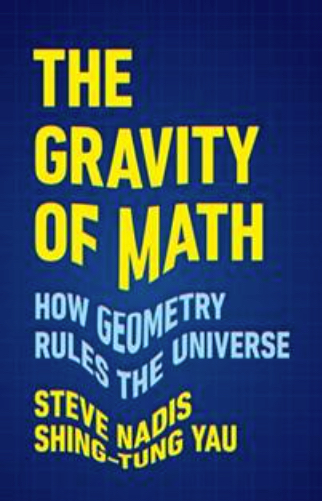
THE GRAVITY OF MATH
How Geometry Rules the Universe
In The Gravity of Math, one of the preeminent mathematicians of the past half century shows how physics and math were combined to give us the theory of gravity and the dizzying array of ideas and insights that has come from it.
In 1915, Albert Einstein published his field equations of general relativity, which transformed our conception of gravity. Rather than being a mysterious force that pulls objects together, gravity, Einstein proclaimed, is merely a consequence of the curvature of space and time. Gravity, in other words, springs from geometry itself.
In The Gravity of Math, the writer Steve Nadis and mathematician Shing-Tung Yau show how Einstein formulated his revolutionary theory, building upon the prior work of Bernhard Riemann, with help from Marcel Grossmann, David Hilbert, Tullio Levi-Civita, and other mathematicians. The book explains how the implications of Einstein's theory have been, and continue to be, uncovered by mathematicians to help us understand phenomena like black holes, gravitational waves, and the Big Bang.
The story of gravity also sheds light on one of the most profound questions of science: Why do our best descriptions of the physical world reduce to mathematical statements? Whatever the answer, one thing is clear: gravity shapes the universe on the largest scales with a reach that is seemingly boundless. So, too, is the reach of mathematics, which can carry us to the edge of infinity and back. ?
Shing-Tung Yau is a mathematics professor at Tsinghua University and professor emeritus at Harvard University. Yau is recipient of a Fields Medal, a MacArthur Fellowship, a National Medal of Science, the Wolf Prize in Mathematics, the Crafoord Prize, the Veblen Prize, among other authors. He is credited with providing a mathematical foundation for string theory. He lives in Beijing.
Steve Nadis is a science writer for dozens of media outlets and a contributing editor at Discover Magazine. He lives in Cambridge, Massachusetts.
Together they have authored four previous books, which have received much praise: The American Journal of Physics reviewed The Shape of Inner Space, describing it as "a portrait of a beautiful branch of geometric analysis as seen through the eyes of one of its pioneers." The Shape of a Life was praised as an "engaging" and "terrific read" (American Scientist), as well as a "compelling portrait" (Physics Today); and it was a finalist for the PROSE Award in Mathematics.
In The Gravity of Math, the writer Steve Nadis and mathematician Shing-Tung Yau show how Einstein formulated his revolutionary theory, building upon the prior work of Bernhard Riemann, with help from Marcel Grossmann, David Hilbert, Tullio Levi-Civita, and other mathematicians. The book explains how the implications of Einstein's theory have been, and continue to be, uncovered by mathematicians to help us understand phenomena like black holes, gravitational waves, and the Big Bang.
The story of gravity also sheds light on one of the most profound questions of science: Why do our best descriptions of the physical world reduce to mathematical statements? Whatever the answer, one thing is clear: gravity shapes the universe on the largest scales with a reach that is seemingly boundless. So, too, is the reach of mathematics, which can carry us to the edge of infinity and back. ?
Shing-Tung Yau is a mathematics professor at Tsinghua University and professor emeritus at Harvard University. Yau is recipient of a Fields Medal, a MacArthur Fellowship, a National Medal of Science, the Wolf Prize in Mathematics, the Crafoord Prize, the Veblen Prize, among other authors. He is credited with providing a mathematical foundation for string theory. He lives in Beijing.
Steve Nadis is a science writer for dozens of media outlets and a contributing editor at Discover Magazine. He lives in Cambridge, Massachusetts.
Together they have authored four previous books, which have received much praise: The American Journal of Physics reviewed The Shape of Inner Space, describing it as "a portrait of a beautiful branch of geometric analysis as seen through the eyes of one of its pioneers." The Shape of a Life was praised as an "engaging" and "terrific read" (American Scientist), as well as a "compelling portrait" (Physics Today); and it was a finalist for the PROSE Award in Mathematics.
| Available products |
|---|
|
Book
Published 2024-04-01 by Basic Books |
|
Book
Published 2024-04-01 by Basic Books |