| Vendor | |
|---|---|

|
Fritz Agency
Christian Dittus |
| Original language | |
| English | |
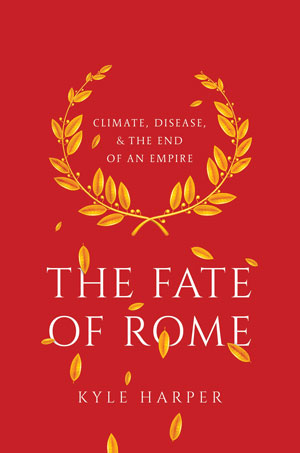
THE FATE OF ROME
Climate, Disease, and the End of an Empire
Here is the monumental retelling of one of the most consequential chapters of human history: the fall of the Roman Empire. THE FATE OF ROME is the first book to examine the catastrophic role that climate change and infectious diseases played in the collapse of Rome's power?a story of nature's triumph over human ambition.
Interweaving a grand historical narrative with cutting-edge climate science and genetic discoveries, Kyle Harper traces how the fate of Rome was decided not just by emperors, soldiers, and barbarians but also by volcanic eruptions, solar cycles, climate instability, and devastating viruses and bacteria. He takes readers from Rome's pinnacle in the second century, when the empire seemed an invincible superpower, to its unraveling by the seventh century, when Rome was politically fragmented and materially depleted. Harper describes how the Romans were resilient in the face of enormous environmental stress, until the besieged empire could no longer withstand the combined challenges of a little ice age and recurrent outbreaks of bubonic plague.
THE FATE OF ROME provides a sweeping account of how one of history's greatest civilizations encountered and endured, yet ultimately succumbed to the cumulative burden of nature's violence. The example of Rome is a timely reminder that climate change and germ evolution have shaped the world we inhabit?in ways that are surprising and profound.
Kyle Harper is professor of classics and letters and senior vice president and provost at the University of Oklahoma.
FATUM
Das Klima und der Untergang des Roemischen Reiches
Deutsch von Anna Leube und Wold Heinrich Leube
[ HC C.H. Beck 03/2020]
Interweaving a grand historical narrative with cutting-edge climate science and genetic discoveries, Kyle Harper traces how the fate of Rome was decided not just by emperors, soldiers, and barbarians but also by volcanic eruptions, solar cycles, climate instability, and devastating viruses and bacteria. He takes readers from Rome's pinnacle in the second century, when the empire seemed an invincible superpower, to its unraveling by the seventh century, when Rome was politically fragmented and materially depleted. Harper describes how the Romans were resilient in the face of enormous environmental stress, until the besieged empire could no longer withstand the combined challenges of a little ice age and recurrent outbreaks of bubonic plague.
THE FATE OF ROME provides a sweeping account of how one of history's greatest civilizations encountered and endured, yet ultimately succumbed to the cumulative burden of nature's violence. The example of Rome is a timely reminder that climate change and germ evolution have shaped the world we inhabit?in ways that are surprising and profound.
Kyle Harper is professor of classics and letters and senior vice president and provost at the University of Oklahoma.
FATUM
Das Klima und der Untergang des Roemischen Reiches
Deutsch von Anna Leube und Wold Heinrich Leube
[ HC C.H. Beck 03/2020]
| Available products |
|---|
|
Book
Published 2017-10-01 by Princeton University Press |