| Vendor | |
|---|---|

|
Fritz Agency
Christian Dittus |
| Original language | |
| English | |
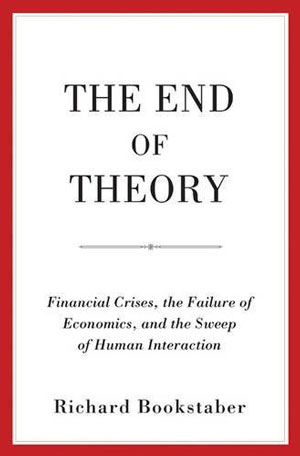
THE END OF THEORY
Financial Crises, the Failure of Economics, and the Sweep of Human Interaction
An in-depth look at how to account for the human complexities at the heart of today's financial system.
Our economy may have recovered from the Great Recession--but not our economics. Richard Bookstaber, one of the world's leading risk managers, discusses why the human condition and the radical uncertainty of our world renders the standard economic model--and the theory behind it--useless for dealing with financial crises. What model should replace it? None. At least not any version we've been using for the past two hundred years. Instead, Bookstaber argues for a new approach called agent-based economics, one that takes as a starting point the fact that we are humans, not the optimizing automatons that standard economics assumes we are.
Bookstaber's groundbreaking paradigm promises to do a far better job at preventing crises and managing those that break out. As he explains, our varied memories and imaginations color our economic behavior in unexpected hues. Agent-based modeling embraces these nuances by avoiding the mechanistic, unrealistic structure of our current economic approach. Bookstaber tackles issues such as radical uncertainty, when circumstances take place beyond our anticipation, and emergence, when innocent, everyday interactions combine to create sudden chaos. Starting with the realization that future crises cannot be predicted by the past, he proposes an approach that recognizes the human narrative while addressing market realities.
Richard Bookstaber has overseen risk management at investment banks Morgan Stanley and Salomon Brothers, as well as major hedge funds such as Moore Capital and Bridgewater. He has also held positions at the U.S. Treasury, and is currently at the University of California.
Our economy may have recovered from the Great Recession--but not our economics. Richard Bookstaber, one of the world's leading risk managers, discusses why the human condition and the radical uncertainty of our world renders the standard economic model--and the theory behind it--useless for dealing with financial crises. What model should replace it? None. At least not any version we've been using for the past two hundred years. Instead, Bookstaber argues for a new approach called agent-based economics, one that takes as a starting point the fact that we are humans, not the optimizing automatons that standard economics assumes we are.
Bookstaber's groundbreaking paradigm promises to do a far better job at preventing crises and managing those that break out. As he explains, our varied memories and imaginations color our economic behavior in unexpected hues. Agent-based modeling embraces these nuances by avoiding the mechanistic, unrealistic structure of our current economic approach. Bookstaber tackles issues such as radical uncertainty, when circumstances take place beyond our anticipation, and emergence, when innocent, everyday interactions combine to create sudden chaos. Starting with the realization that future crises cannot be predicted by the past, he proposes an approach that recognizes the human narrative while addressing market realities.
Richard Bookstaber has overseen risk management at investment banks Morgan Stanley and Salomon Brothers, as well as major hedge funds such as Moore Capital and Bridgewater. He has also held positions at the U.S. Treasury, and is currently at the University of California.
| Available products |
|---|
|
Book
Published 2017-04-01 by Princeton University Press |