| Vendor | |
|---|---|

|
Mohrbooks Literary Agency
Sebastian Ritscher |
| Original language | |
| English | |
| Categories | |
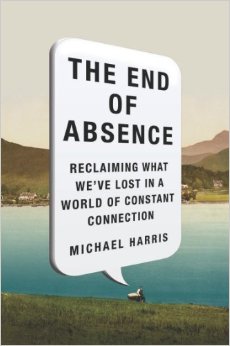
THE END OF ABSENCE
Reclaiming What We've Lost in a World of Constant Connection
An exploration of the Gutenberg-scale shift experienced by those who've lived with and without the Internet, focusing on the social, physiological, and psychological changes that come when we are given access to as much information and interaction as we want, pitched as in the tradition of Sherry Turkle and Chris Anderson
Michael Harris expresses the singular experience of living through the greatest technological translation of this age. We could describe the “straddle generation”—the people who know life before and after the rise of the Internet—as, roughly, any person born before 1980. Now, we wonder at the constant presence of information and the access to anything we fancy—but we rarely stop to consider what we’ve given up in exchange for such connectedness.
Popular opinion is that technology has improved our lives, but what exactly have we lost on our way to a life of instant access to everything? Harris argues that the specific thing this world has lost is lack. He paints a portrait of separate aspects of life that have been altered; his chapters focus on changes in sex, memory, attention span, etc.
THE END OF ABSENCE focuses on the experience of losing a quality of absence in our lives—in other words, the experience of being flooded by constant connection. When online life so wholly takes over our daily experience, what invisible things begin to drop away? Because here’s the thing about losing absence: once you’ve lost it, it’s very, very difficult to recall its value.
As author Michael Harris writes in the proposal, “Only one generation in history, ours, will live before and after the rise of the Internet. It falls on us, then, to document the experience of this change. Our children will no more be able to see online life for what it is than we can really see the changes wrought by Gutenberg’s printing press.” Harris is a contributing editor at Western Living and Vancouver magazine.
Popular opinion is that technology has improved our lives, but what exactly have we lost on our way to a life of instant access to everything? Harris argues that the specific thing this world has lost is lack. He paints a portrait of separate aspects of life that have been altered; his chapters focus on changes in sex, memory, attention span, etc.
THE END OF ABSENCE focuses on the experience of losing a quality of absence in our lives—in other words, the experience of being flooded by constant connection. When online life so wholly takes over our daily experience, what invisible things begin to drop away? Because here’s the thing about losing absence: once you’ve lost it, it’s very, very difficult to recall its value.
As author Michael Harris writes in the proposal, “Only one generation in history, ours, will live before and after the rise of the Internet. It falls on us, then, to document the experience of this change. Our children will no more be able to see online life for what it is than we can really see the changes wrought by Gutenberg’s printing press.” Harris is a contributing editor at Western Living and Vancouver magazine.
| Available products |
|---|
|
Book
Published 2014-08-07 by Current |
|
Book
Published 2014-08-07 by Current |