| Vendor | |
|---|---|

|
Liepman Literary Agency
Marc Koralnik |
| Original language | |
| English | |
| Weblink | |
| http://www.overlookpress.com/up- … | |
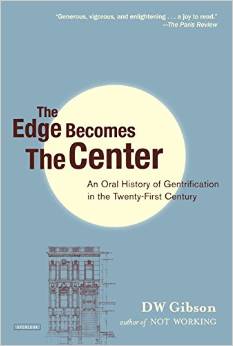
THE EDGE BECOMES THE CENTRE.
An Oral History of Gentrification in the Twenty-First Century
In the plainspoken, casually authoritative tradition of Jane Jacobs and Studs Terkel, THE EDGE BECOMES THE CENTRE is an inviting and essential portrait of the way we live now.
If you live in a cityand every year, more and more Americans doyou've seen firsthand how gentrification has transformed our surroundings. Gentrification has so altered the way cities look, feel, cost, and even smell to such an extent that it's hard to imagine that it could ever have been otherwise. Over the last few years, journalists, policymakers, critics, and historians have all tried to explain just what it is that happens when new money and new residents flow in, yet we've had very little access to the human side of this phenomenon.
THE EDGE BECOMES THE CENTRE captures the stories of the many kinds of peoplebrokers, buyers, sellers, renters, landlords, artists, contractors, politicians and everyone in betweenwho are being shaped byand are shapingthe new New York City. In this extraordinary oral history, DW Gibson takes gentrification out of the op-ed columns and the textbooks and brings it to life. Gibson explainsin the voices of the people living through itwhat urban change really looks and feels like.
DW Gibson is the author of Not Working: People Talk About Losing a Job and Finding Their Way in Today's Changing Economy. His work has appeared in publications such as The New York Times, The New York Observer, The Daily Beast, BOMB, and The Caravan. Gibson serves as director of Writers Omi at Ledig House in Ghent, New York, which is part of the Omi International Arts Center. He is also the co-founder and co-director of Sangam House, a writers' residency in India. He lives with his wife and daughter in New York City.
THE EDGE BECOMES THE CENTRE captures the stories of the many kinds of peoplebrokers, buyers, sellers, renters, landlords, artists, contractors, politicians and everyone in betweenwho are being shaped byand are shapingthe new New York City. In this extraordinary oral history, DW Gibson takes gentrification out of the op-ed columns and the textbooks and brings it to life. Gibson explainsin the voices of the people living through itwhat urban change really looks and feels like.
DW Gibson is the author of Not Working: People Talk About Losing a Job and Finding Their Way in Today's Changing Economy. His work has appeared in publications such as The New York Times, The New York Observer, The Daily Beast, BOMB, and The Caravan. Gibson serves as director of Writers Omi at Ledig House in Ghent, New York, which is part of the Omi International Arts Center. He is also the co-founder and co-director of Sangam House, a writers' residency in India. He lives with his wife and daughter in New York City.
| Available products |
|---|
|
Book
Published 2015-05-01 by Overlook |