| Vendor | |
|---|---|

|
Liepman Literary Agency
Marc Koralnik |
| Original language | |
| English | |
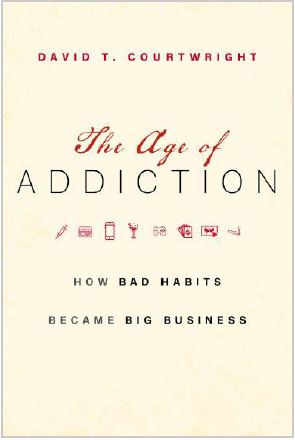
THE AGE OF ADDICTION
How Bad Habits Became Big Business
From an expert on addiction, a authoritative history of how global businesses have targeted the human brain's reward centers, driving us to addictions ranging from oxycodone to Fortnite to Snapchat, with alarming social consequences.
We live in an age of addiction, from compulsive gaming and shopping to binge eating and opioid abuse. Sugar can be as habit-forming as cocaine, researchers tell us, and social media apps are hooking our kids. But what can we do to resist temptations that insidiously and deliberately rewire our brains? Nothing, David Courtwright says, unless we understand the history and character of the global enterprises that create and cater to our bad habits.
The Age of Addiction chronicles the triumph of limbic capitalism, the growing network of competitive businesses targeting the brain pathways responsible for feeling, motivation, and long-term memory. We see its success in Steve Wynn's groundbreaking casinos and Purdue Pharma's pain pills, in McDonald's engineered burgers and Tencent video games from China. All capitalize on the ancient quest to discover, cultivate, and refine new and habituating pleasures. The business of satisfying desire assumed a more sinister aspect with the rise of long-distance trade, plantation slavery, anonymous cities, large corporations, and sophisticated marketing. Multinational industries, often with the help of complicit governments and criminal organizations, have multiplied and cheapened seductive forms of brain reward, from junk food to pornography. The internet has brought new addictions: in 2018, the World Health Organization added
gaming disorder to its International Classification of Diseases.
Courtwright holds out hope that limbic capitalism can be contained by organized opposition from across the political spectrum. Progressives, nationalists, and traditionalists have made common cause against the purveyors of addiction before. They could do it again.
David T. Courtwright is Presidential Professor at the University of North Florida and the author of Dark Paradise: A History of Opiate Addiction in America and Forces of Habit: Drugs and the Making of the Modern World, translated in complex and simplified Chinese, French, Japanese, Spanish, and Swedish. He was an inaugural recipient of the highly competitive NEH Public Scholar Grant and is a regular media commentator on the history of addiction.
The Age of Addiction chronicles the triumph of limbic capitalism, the growing network of competitive businesses targeting the brain pathways responsible for feeling, motivation, and long-term memory. We see its success in Steve Wynn's groundbreaking casinos and Purdue Pharma's pain pills, in McDonald's engineered burgers and Tencent video games from China. All capitalize on the ancient quest to discover, cultivate, and refine new and habituating pleasures. The business of satisfying desire assumed a more sinister aspect with the rise of long-distance trade, plantation slavery, anonymous cities, large corporations, and sophisticated marketing. Multinational industries, often with the help of complicit governments and criminal organizations, have multiplied and cheapened seductive forms of brain reward, from junk food to pornography. The internet has brought new addictions: in 2018, the World Health Organization added
gaming disorder to its International Classification of Diseases.
Courtwright holds out hope that limbic capitalism can be contained by organized opposition from across the political spectrum. Progressives, nationalists, and traditionalists have made common cause against the purveyors of addiction before. They could do it again.
David T. Courtwright is Presidential Professor at the University of North Florida and the author of Dark Paradise: A History of Opiate Addiction in America and Forces of Habit: Drugs and the Making of the Modern World, translated in complex and simplified Chinese, French, Japanese, Spanish, and Swedish. He was an inaugural recipient of the highly competitive NEH Public Scholar Grant and is a regular media commentator on the history of addiction.
| Available products |
|---|
|
Book
Published 2019-05-01 by Harvard University Press |