| Vendor | |
|---|---|

|
Fritz Agency
Christian Dittus |
| Original language | |
| English | |
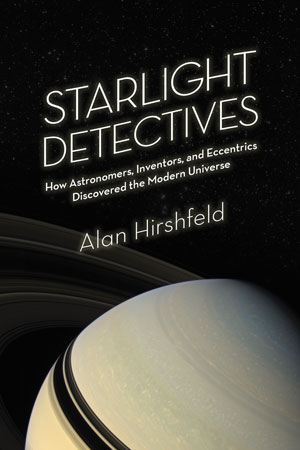
STARLIGHT DETECTIVES
How Astronomers, Inventors, and Eccentrics Discovered the Modern Universe
In 1929, Edwin Hubble announced the greatest discovery in the history of astronomy since Galileo first turned a telescope to the heavens. The galaxies, previously believed to float serenely in the void, are in fact hurtling apart at an incredible speed: the universe is expanding. This stunning discovery was the culmination of a decades-long arc of scientific and technical advancement. In its shadow lies an untold, yet equally fascinating, backstory whose cast of characters illuminates the gritty, hard-won nature of scientific progress.
The path to a broader mode of cosmic observation was blazed by a cadre of nineteenth-century amateur astronomers and inventors, galvanized by the advent of photography, spectral analysis, and innovative technology to create the entirely new field of astrophysics. From William Bond, who turned his home into a functional observatory, to John and Henry Draper, a father and son team who were trailblazers of astrophotography and spectroscopy, to geniuses of invention such as Léon Foucault, and George Hale, who founded the Mount Wilson Observatory, Hirshfeld reveals the incredible storiesand the ambitious dreamersbehind the birth of modern astronomy.
Alan Hirshfeld,Professor of Physics at the University of Massachusetts Dartmouth and an Associate of the Harvard College Observatory, received his undergraduate degree in astrophysics from Princeton and his Ph.D. in astronomy from Yale. He is the author of Parallax: The Race to Measure the Cosmos, The Electric Life of Michael Faraday, and Eureka Man: The Life and Legacy of Archimedes. He is a regular book reviewer for the Wall Street Journal and has contributed to Sky & Telescope, the American Journal of Physics, BBC History Magazine, and American Scientist. He has made radio and television appearances on NPR, PBS, and C-SPAN and lectures nationwide about science history and discovery.
The path to a broader mode of cosmic observation was blazed by a cadre of nineteenth-century amateur astronomers and inventors, galvanized by the advent of photography, spectral analysis, and innovative technology to create the entirely new field of astrophysics. From William Bond, who turned his home into a functional observatory, to John and Henry Draper, a father and son team who were trailblazers of astrophotography and spectroscopy, to geniuses of invention such as Léon Foucault, and George Hale, who founded the Mount Wilson Observatory, Hirshfeld reveals the incredible storiesand the ambitious dreamersbehind the birth of modern astronomy.
Alan Hirshfeld,Professor of Physics at the University of Massachusetts Dartmouth and an Associate of the Harvard College Observatory, received his undergraduate degree in astrophysics from Princeton and his Ph.D. in astronomy from Yale. He is the author of Parallax: The Race to Measure the Cosmos, The Electric Life of Michael Faraday, and Eureka Man: The Life and Legacy of Archimedes. He is a regular book reviewer for the Wall Street Journal and has contributed to Sky & Telescope, the American Journal of Physics, BBC History Magazine, and American Scientist. He has made radio and television appearances on NPR, PBS, and C-SPAN and lectures nationwide about science history and discovery.
| Available products |
|---|
|
Book
Published 2014-07-01 by Bellevue Literary Press |