Skip to content
Responsive image
Vendor
Mohrbooks Literary Agency
Sebastian Ritscher
Original language
English
Categories

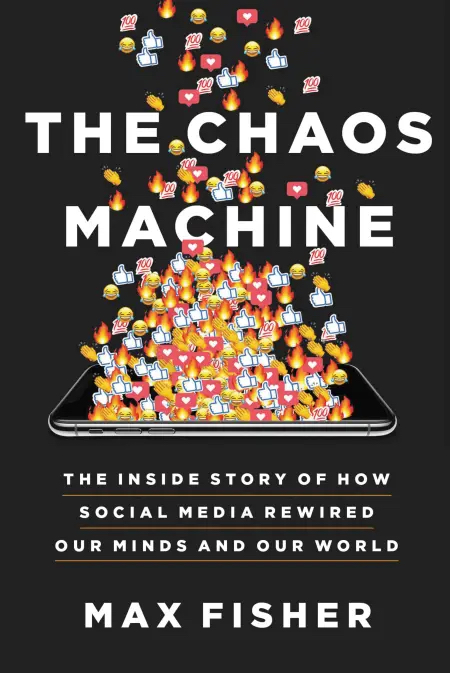
THE CHAOS MACHINE

Max Fisher

The Inside Story of How Social Media Rewired Our Minds and Our World

From a New York Times investigative reporter and Pulitzer Prize finalist comes a gripping narrative that fuses research, exclusive interviews, and on-the-ground reporting to capture the full inside story of Big Tech's monomaniacal race to drive engagement - and profits - at all costs.
The Chaos Machine is the story of how the world was driven mad by social media. The election of populists like Trump and Bolsonaro; strife and genocide in countries like Myanmar; the rampant spread of COVID-19 conspiracy theories as deadly as the pandemic itself; all of these are products of a breakdown in our social and political lives, a breakdown driven by the apps, companies and algorithms that compete constantly for our attention.

Max Fisher is a leading New York Times technology reporter whose work has covered the way that social media sites - driven increasingly by artificial intelligence rather than human ingenuity - push users towards more and more extreme positions, deepening the divisions in society in pursuit of greater engagement and profit. With extraordinary access to the most powerful players in Silicon Valley, and with testimonies from around the world of the havoc being wreaked by our online selves, The Chaos Machine shows us how we got to this uniquely perilous moment - and how we might get out of it.

Max Fisher is an international reporter and columnist for The New York Times. He has reported from five continents on conflict, diplomacy, social change and other topics. He writes The Interpreter, a column exploring the ideas and context behind major world events. A weekly newsletter of the same name features original reporting and insights. He is based in New York. Before joining The Times in 2016, he launched several web-based projects aimed at expanding the audience for foreign news. This included, in 2011, an international news vertical for The Atlantic magazine; in 2012, the Washington Post's foreign news blog, WorldViews; and, in 2014, as one of the founding editors of Vox.com. He lives in Washington, DC.
Available products
Book

Published 2022-09-06 by Little, Brown

Book

Published 2022-09-06 by Little, Brown

Comments

Max Fisher blends together deep reporting, riveting stories, and a global canvas in this gripping and definitive work on the damage wrought by social media. The Chaos Machine is essential reading if you want to understand a force that is reshaping the world and the very real consequences it is having on people everywhere.

UK: Querkus ; Arabic: Wasm Publishing ; French: Editions Marie Romaine ; Italian: Linkiesta ; Japanese: Hakuyo-Sha ; Korean: J-PUB ; Poland: Otwarte ; Portuguese (Brazil): Todavia ; Spanish (World): Planeta

A stark warning about the extent to which Facebook et al distort our perception of reality'. Read more...

An often riveting, disturbing examination of the social media labyrinth and the companies that created it... Fisher dives into the chaotic social media landscape, synthesizing dozens of interviews from a wide range of sources... he examines the rise of the social media giants and the dangers they have created for our society... Fisher is spot-on when he describes how the promotion and manufacture of moral outrage were not glitches in the system but inherent features.

Social media isn't just changing our lives. It's changing the world, and even its creators and would-be overseers have only the foggiest ideas about how. In this meticulously reported, grippingly told account, Max Fisher chases the results across continents, and paints a disturbing picture of not just where we are, but where we're going. The Chaos Machine is an essential book for our times.

[An] authoritative and devastating account of the impacts of social media.utterly convincing and should obliterate any doubts about the significance of algorithmic intervention in human affairs.In Fisher's rigorous quest to understand how social media might have 'rewired our minds,' he interviews many psychologists about their academic studies, and discovers insights that will fascinate readers.The lesson of Fisher's book is surely that we don't need more celestial inspirations for ambitious projects of human transformation. Rather, we need to make individual members of societies resistant to such efforts. We have the means to do so if the political will is strong enough, and if our political system hasn't yet been wrecked by the chaos machine.

In this timely book, Max Fisher reveals how powerful social-media giants set all of humanity on an alternative course to the future. The Chaos Machine boldly exposes how a few technology companies chose profit over people, helped spread salacious misinformation, and ultimately ripped the fabric of society apart. I hope everyone will read this important investigation with an open mind, because we must choose a different path forward, and fast.

Journalist Fisher's first book is a well-researched and thoroughly unnerving argument that social media is by its very nature designed to destabilize and polarize its users... Fisher's conclusion is blunt: on an individual level, users should turn social media off - or at the very least, social media companies should turn off the algorithms that lead users down dangerous rabbit holes, essentially restoring programs like Facebook to their original states. Fisher's lucid, clear explanations and convincing arguments are bound to leave readers questioning their own use of social media.

SOCIAL DISORDER will be a major piece of publishing for us: with the author's trail of widely read NYT pieces and impressive network of media contacts, combined with our experience publishing ground-breaking non-fiction bestsellers, we plan to make this one of the most talked-about and read books of the year. [...] SOCIAL DISORDER is one of the strongest, deepest proposals I can remember reading, and one that has informed my thinking ever since I first read through it. [...] Max's writing evinces the kind of deep familiarity with Silicon Valley's mindset that is necessary to write a convincing book of this kind, while remaining completely clear-eyed about that mindset and its strange, troubling limitations: the amount of reporting both on Silicon Valley's most important figures and on their very distant victims is perfectly balanced, and I struggle to imagine any other writer being able to get as much access to all sides of this issue.

...The Chaos Machine's greatest achievement is perhaps how skilfully it traces seemingly disparate phenomena - Gamergate, QAnon, civil unrest in Myanmar, rising polarisation in the West, thriving anti-vax Facebook groups among many examples - back to the design of social media platforms that prioritise engagement at all costs... Read more...

[W]hat's impressive here is how Fisher brings it all together: the breadth of information, covering everything from the intricacies of engagement-boosting algorithms to theories of sentimentalism, makes this a one-stop shop. It's a well-researched, damning picture of just what happens online. Read more...

Max Fisher's The Chaos Machine is a deep dive into the strategies employed by tech giants to create the most addictive possible platforms for users, all in the name of 'engagement.' But it's more than mere distraction: Silicon Valley algorithms have long-favored the lurid, the titillating, and the sensational - irrespective of any connection to reality - and have essentially created generations of dopamine-hungry screen addicts (hi!) at the mercy of their phones and the lies they tell. Read more...

THE CHAOS MACHINE has gone to #3 on Amazon for books on Computers & Technology Industry, #3 for their Women in History section, and #10 for Medical Social Psychology & Interactions.

All of us, I think, have a good sense of the pervasive negative uses of social media, and an intuition about the ways in which aspects of it aren't psychologically healthy for us - and particularly for our children. The story that Fisher tells confirms and gives shape and substance to those intuitions. He does this by guiding us fluidly through the ways that social media affects 1) human behavior, 2) our communities, and 3) the world, particularly liberal democracies, in large part by preying on psychological vulnerabilities for which humans have spent millennia building up safeguards that are now being consistently undermined.