| Vendor | |
|---|---|

|
Liepman Literary Agency
Marc Koralnik |
| Original language | |
| French | |
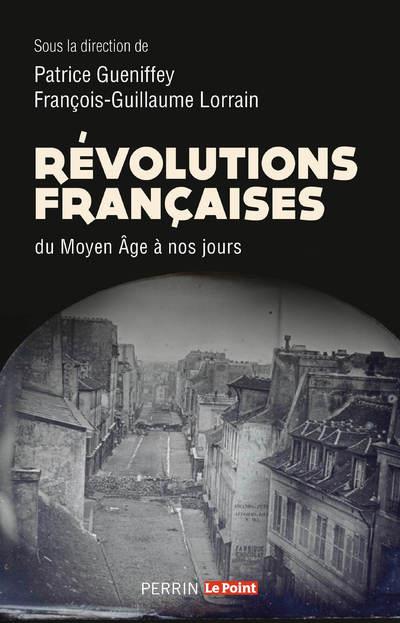
RÉVOLUTIONS FRANCAISES DU MOYEN ÂGE À NOS JOURS
Patrice Gueniffey François-Guillaume Lorrain
The history of the upheavals that have continuously pitted the French against the French from the Middle Ages onward. A timely analysis.
Absolute monarchy, Consulate, Empires, Presidential Republic France seems deeply committed to a certain vertical idea of power and its corollary: the guarantee of public order. However, this devotion coincides precisely with a chronic instability, testifying to the people's recurring rebellion against those in power, combined with a rivalry at the top that had long pitted the throne against the nobility, until the rise of the bourgeoisie changed the game and reshuffled the cards several times between 1789 and 1870. At last count, France has known two Empires, three types of monarchy (Ancien Régime, Restoration, July Monarchy) and five Republics.
What is the real history of these major upheavals that date back to the Middle Ages, of which the prolonged Yellow Vests crisis is the most recent manifestation? What role did the people play each time and, moreover, what people are we talking about? How did the government respond and with what forces? These are the questions, among many others, tackled by the best writers from the weekly magazine Le Point and Perrin in their authoritative essays.
Summary
1. The va-nus-pieds (Yves-Marie-Bercé)
2. Etienne Marcel (Georges Minois)
3. The League (François-Guillaume Lorrain)
4. The Fronde (Emmanuel Hecht)
5. October 1789 (Michel Biard)
6. August 1792 (Charles-Eloi Vial)
7. Spring 1793 (fall of the Girondins) (Patrice Gueniffey)
8. 1830 (Camille Pascal)
9. February 1848 (Marie-Hélène Baylac)
10. June 1848 (Arnaud Teyssier)
11. September 4, 1870 (Eric Anceau)
12. The Commune (Hélène Lewandowski)
13. February 6, 1934 (Renaud Meltz)
14. 1947, the civil Cold War (Robert Mencherini)
15. May 68 (Gérard Courtois)
16. The Yellow Vests (Said Mahrane)
A professor at the Ecole des Hautes Etudes en Sciences Sociales (EHESS), PATRICE GUENIFFEY has written Le nombre et la raison (The number and the reason) (1993), La politique de la Terreur, Essai sur la violence révolutionnaire (The politics of the Terror, essay on revolutionary violence) (2000) and the critically acclaimed Le 18 Brumaire, L'épilogue de la Révolution française (18 Brumaire, epilogue of the French revolution)(2008). He has since edited top historians in the collective book Les derniers jours des rois (Last Days of the Kings)(2014).
A historian and correspondent for Le Point, graduate of the Ecole Normale Supérieure with a doctorate in letters, FRANÇOIS-GUILLAUME LORRAIN has published a dozen remarkable books, including Ces lieux qui ont fait la France (These places that made France) (Fayard).
What is the real history of these major upheavals that date back to the Middle Ages, of which the prolonged Yellow Vests crisis is the most recent manifestation? What role did the people play each time and, moreover, what people are we talking about? How did the government respond and with what forces? These are the questions, among many others, tackled by the best writers from the weekly magazine Le Point and Perrin in their authoritative essays.
Summary
1. The va-nus-pieds (Yves-Marie-Bercé)
2. Etienne Marcel (Georges Minois)
3. The League (François-Guillaume Lorrain)
4. The Fronde (Emmanuel Hecht)
5. October 1789 (Michel Biard)
6. August 1792 (Charles-Eloi Vial)
7. Spring 1793 (fall of the Girondins) (Patrice Gueniffey)
8. 1830 (Camille Pascal)
9. February 1848 (Marie-Hélène Baylac)
10. June 1848 (Arnaud Teyssier)
11. September 4, 1870 (Eric Anceau)
12. The Commune (Hélène Lewandowski)
13. February 6, 1934 (Renaud Meltz)
14. 1947, the civil Cold War (Robert Mencherini)
15. May 68 (Gérard Courtois)
16. The Yellow Vests (Said Mahrane)
A professor at the Ecole des Hautes Etudes en Sciences Sociales (EHESS), PATRICE GUENIFFEY has written Le nombre et la raison (The number and the reason) (1993), La politique de la Terreur, Essai sur la violence révolutionnaire (The politics of the Terror, essay on revolutionary violence) (2000) and the critically acclaimed Le 18 Brumaire, L'épilogue de la Révolution française (18 Brumaire, epilogue of the French revolution)(2008). He has since edited top historians in the collective book Les derniers jours des rois (Last Days of the Kings)(2014).
A historian and correspondent for Le Point, graduate of the Ecole Normale Supérieure with a doctorate in letters, FRANÇOIS-GUILLAUME LORRAIN has published a dozen remarkable books, including Ces lieux qui ont fait la France (These places that made France) (Fayard).
| Available products |
|---|
|
Book
Published 2020-02-01 by Perrin |