| Vendor | |
|---|---|

|
Liepman Literary Agency
Marc Koralnik |
| Original language | |
| English | |
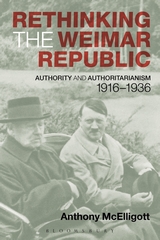
RETHINKING THE WEIMAR REPUBLIC
Authority and Authoritarianism, 1916-1936
stretches the chronological-political parameters of the republic from 1916 to 1936 in a study that challenges conventional approaches to its history.
This study challenges conventional approaches to the history of the Weimar Republic by stretching its chronological-political parameters from 1916 to 1936, arguing that neither 1918 nor 1933 constituted distinctive breaks in early 20th-century German history. - Covers all of the key debates such as inheritance of the past, the nature of authority and culture - Rethinks topics of traditional concern such as the economy, Article 48, the Nazi vote and political violence - Discusses hitherto neglected areas, such as provincial life and politics, the role of law and Republican cultural politics Comments below on Anthony McElligott's Rethinking the Weimar Republic, from Professor Dirk Schumann, Chair of Modern and Contemporary History, Georg August University, Goettingen, Germany. While not a comprehensive new account of the history of the Weimar Republic, McElligott's book is a thought-provoking study of one particular aspect, i.e. of how the Republic attempted to establish its authority. Its key argument is original (and in line with recent scholarship): republican ideas and practices of establishing authority included more authoritarian elements than previously noted, thus creating overlooked continuities with the period before and after and blurring boundaries between supporters and enemies of the republic. Most innovative is the chapter on cultural authority, where the McElligott shows how republican self-representation included links to Imperial Germany and took a chauvinist turn with the celebration of the liberation of the Rhineland in 1930, dispelling the myth of a republic unable to reach the minds and hearts in public performances. Equally insightful and based on extensive primary sources is the chapter on the judiciary, showing both that judges' sentencing practices were influenced more by an overall trend towards replacing prison terms by fines than by specific political motives and that the republic itself made use of extraordinary courts to a substantial degree. The chapter on the Landrat as renegade authority raises productive questions about everyday practice of state authority, which will stimular further research. Other chapters strike me primarily as summaries of existing scholarship. Overall, the book will trigger debates about how finding parallels in form and substance of establishing state authority between late Imperial Germany, the Weimar Republic, and the Nazi state is to change our view of the Republic as different in character and how we are to gauge the chances of Weimar to survive in the light of those parallels.
| Available products |
|---|
|
Book
Published 2023-05-11 by Bloomsbury Academic |