| Vendor | |
|---|---|

|
Mohrbooks Literary Agency
Sebastian Ritscher |
| Original language | |
| English | |
| Categories | |
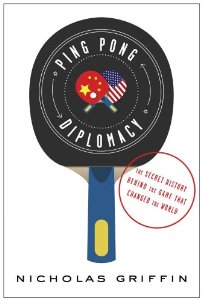
PING PONG DIPLOMACY
The Secret History Behind the Game that Changed the World
Ping-Pong Diplomacy traces a crucial inter section of sports and society.
THE SPRING OF 1971 heralded the greatest geopolitical realignment in a generation. After twenty-two years of antagonism, China and the United States suddenly moved toward a détente—achieved not by politicians but by Ping-Pong players. The Western press delighted in the absurdity of the moment and branded it “Ping-Pong Diplomacy.” But for the Chinese, Ping-Pong was always political, a strategic cog in Mao Zedong’s foreign policy. Nicholas Griffin proves that the organized game, from its first breath, was tied to Communism thanks to its founder, Ivor Montagu, son of a wealthy English baron and spy for the Soviet Union.
Ping-Pong Diplomacy traces a crucial inter section of sports and society. Griffin tells the strange and tragic story of how the game was manipulated at the highest levels; how the Chinese government helped cover up the death of 36 million peasants by holding the World Table Tennis Championships during the Great Famine; how championship players were driven to their deaths during the Cultural Revolution; and, finally, how the survivors were reconvened in 1971 and ordered to reach out to their American counterparts. Through a cast of eccentric characters, from spies to hippies and Ping-Pong-obsessed generals to atom-bomb survivors, Griffin explores how a neglected sport was used to help realign the balance of worldwide power.
Griffin, an Englishman living in New York, stumbled upon his subject after spending two weeks in Beijing during the 2008 Olympics and quickly became intrigued. After discovering a family connection to Ivor Montagu, interest turned into obsession. With this singular story, Griffin animates the greatest realignment of superpowers in our lifetime through a cast of mostly obscure, eccentric, psychologically compelling characters, against the backdrop of clashing cultures, sports, class, and diplomacy. Nicholas Griffin is the author of four novels and one nonfiction book, Caucasus.
Ping-Pong Diplomacy traces a crucial inter section of sports and society. Griffin tells the strange and tragic story of how the game was manipulated at the highest levels; how the Chinese government helped cover up the death of 36 million peasants by holding the World Table Tennis Championships during the Great Famine; how championship players were driven to their deaths during the Cultural Revolution; and, finally, how the survivors were reconvened in 1971 and ordered to reach out to their American counterparts. Through a cast of eccentric characters, from spies to hippies and Ping-Pong-obsessed generals to atom-bomb survivors, Griffin explores how a neglected sport was used to help realign the balance of worldwide power.
Griffin, an Englishman living in New York, stumbled upon his subject after spending two weeks in Beijing during the 2008 Olympics and quickly became intrigued. After discovering a family connection to Ivor Montagu, interest turned into obsession. With this singular story, Griffin animates the greatest realignment of superpowers in our lifetime through a cast of mostly obscure, eccentric, psychologically compelling characters, against the backdrop of clashing cultures, sports, class, and diplomacy. Nicholas Griffin is the author of four novels and one nonfiction book, Caucasus.
| Available products |
|---|
|
Book
Published 2014-01-01 by Scribner |
|
Book
Published 2014-01-01 by Scribner |