| Vendor | |
|---|---|

|
Mohrbooks Literary Agency
Sebastian Ritscher |
| Original language | |
| English | |
| Categories | |
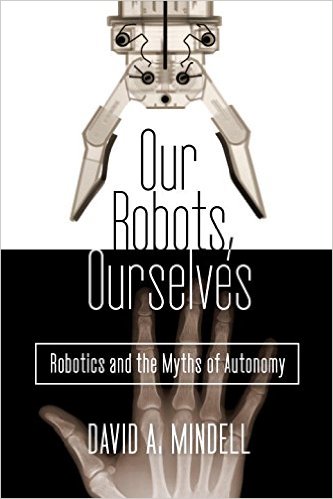
OUR ROBOTS, OURSELVES
Robotics and the Myths of Autonomy
MIT professor David Mindell takes on the myths of robotics, exploring the extreme environments where automated machines are already employed, making a provocative argument for the crucial role of people in a changing technological landscape.
Where can we find the most cutting-edge robotics today? And what can those sites tell us about the future of robotics and the rapidly changing relationships between human and machine? In Our Robots, Ourselves, David Mindell takes us to the extreme environments—high atmosphere, deep ocean, and outer space—to show us where the most advanced robotics already exist. In these environments, we employ vision systems far ahead of Google Glass; require complex 150-person networks for a single drone system; help scientists to “commute,” albeit remotely, to Mars to conduct daily experiments; discover new information about ancient civilizations; and map some of our world’s largest energy reserves.
These are sites of tremendous experimentation and innovation, but also places where technology’s social and cognitive effects on humans first emerge. The tools of air, sea, and space forecast the dangers, ethical quandaries, and unintended consequences of a future in which robotics and automation suffuse our everyday lives. And yet they also show us the furthest edges of what the combination of the human and the technological can do for society.
Our Robots, Ourselves argues that the stark lines we’ve drawn between human and not-human, manual and automated, aren’t helpful for understanding our relationship with robotics. Human decisions, presence, and expertise are shifting with new technological developments. It is not the robots themselves but the novel mixtures of human- and automated- machines that are changing the nature of the work and the people who do it. Employing firsthand experience, extensive interviews, and the latest research from MIT and elsewhere, Mindell shows how people operate with and through robots and automated systems and how these interactions will continue to impact our work, experiences, and professional identities in the coming years.
Mindell has firsthand knowledge of robotics as an engineer in deep sea exploration (alongside Bob Ballard, most famous for discovering the Titanic wreck), and more recently as an airplane pilot and engineer of autonomous aircraft. A vivid storyteller with an expertise that puts him at the cutting edge of a rapidly transforming field, Mindell’s analysis will change the public’s misconceptions about the autonomous robot and instead conveys a hopeful message about what he calls “rich human presence.”
David A. Mindell is the Dibner Professor of the History of Engineering and Manufacturing and Professor of Aerospace Engineering at MIT. He is an award-winning author of several books on technology, most recently Digital Apollo (MIT, 2008), which won the Eugene Emme award from the American Society of Astronautics and the Gardner-Lasser Award from the American Institute of Aeronautics and Astronautics.
These are sites of tremendous experimentation and innovation, but also places where technology’s social and cognitive effects on humans first emerge. The tools of air, sea, and space forecast the dangers, ethical quandaries, and unintended consequences of a future in which robotics and automation suffuse our everyday lives. And yet they also show us the furthest edges of what the combination of the human and the technological can do for society.
Our Robots, Ourselves argues that the stark lines we’ve drawn between human and not-human, manual and automated, aren’t helpful for understanding our relationship with robotics. Human decisions, presence, and expertise are shifting with new technological developments. It is not the robots themselves but the novel mixtures of human- and automated- machines that are changing the nature of the work and the people who do it. Employing firsthand experience, extensive interviews, and the latest research from MIT and elsewhere, Mindell shows how people operate with and through robots and automated systems and how these interactions will continue to impact our work, experiences, and professional identities in the coming years.
Mindell has firsthand knowledge of robotics as an engineer in deep sea exploration (alongside Bob Ballard, most famous for discovering the Titanic wreck), and more recently as an airplane pilot and engineer of autonomous aircraft. A vivid storyteller with an expertise that puts him at the cutting edge of a rapidly transforming field, Mindell’s analysis will change the public’s misconceptions about the autonomous robot and instead conveys a hopeful message about what he calls “rich human presence.”
David A. Mindell is the Dibner Professor of the History of Engineering and Manufacturing and Professor of Aerospace Engineering at MIT. He is an award-winning author of several books on technology, most recently Digital Apollo (MIT, 2008), which won the Eugene Emme award from the American Society of Astronautics and the Gardner-Lasser Award from the American Institute of Aeronautics and Astronautics.
| Available products |
|---|
|
Book
Published 2015-10-13 by Viking |
|
Book
Published 2015-10-13 by Viking |