| Vendor | |
|---|---|

|
Mohrbooks Literary Agency
Sebastian Ritscher |
| Original language | |
| English | |
| Categories | |
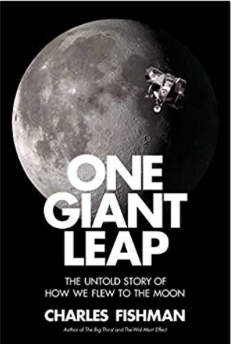
ONE GIANT LEAP
The Impossible Mission That Flew Us to the Moon
One Giant Leap details the race to the Moon and ways it changed our world forever.
On September 12, 1962, President John Kennedy delivered his speech before a crowd of 40,000 people asserting that America would put a man on the moon by the end of the decade. At the time, the United States lagged behind the Soviet Union's space achievements. They had launched Sputnik 1 almost 4 years earlier and in 1961, Russian cosmonaut Yuri Gagarin became the first man in space. At the time of Kennedy's speech, the United States had exactly 15 minutes of manned spaceflight experience - of which just 5 minutes was outside the Earth's atmosphere. No American had been sent into orbit and NASA had no idea how to fly to the moon. No one knew how to build a rocket big enough to fly to the Moon. No one knew how to build a computer small enough to put on that rocket. No one knew how to feed astronauts in space, and no one knew how astronauts would even use the bathroom in space. And NASA had just nine years to make it happen. Kennedy had vowed to do something that, at that moment, couldn't be done. Eight years later - eight years and two months - one astronaut was orbiting the Moon, and two were bouncing around on the surface. To fulfill President Kennedy's mandate, NASA engineers had to invent space from scratch.
In One Giant Leap, Charles Fishman introduces readers to the men and women tasked with putting a man on the moon. From the halls of MIT, where the eccentric and legendary digital pioneer Charles Draper created the two computers aboard Apollo 11, to the factories where hundreds of women weaved computer programs with copper wire, Fishman captures the sweeping achievement of these ordinary men and women charged with changing the world as we know it. Fishman shows that a program born in a politically-charged race ended up bringing the world together through the technology that was developed along the journey. It was space culture that changed the perception about the appeal of technology and the usefulness of technology. The space program and the aura of imaginative enthusiasm that it brought with it changed the tone of technology, the attitude it presented to us, and the attitude we brought to it. That's the sense in which the culture of manned space travel helped lay the groundwork for the digital age. Space didn't get us ready for space, it got us ready for the digital world that was coming on Earth.
Charles Fishman is the acclaimed author of A Curious Mind (with Brian Grazer), The Wal-Mart Effect, and The Big Thirst. He is a three-time winner of the Gerald Loeb Award, the most prestigious prize in business journalism.
In One Giant Leap, Charles Fishman introduces readers to the men and women tasked with putting a man on the moon. From the halls of MIT, where the eccentric and legendary digital pioneer Charles Draper created the two computers aboard Apollo 11, to the factories where hundreds of women weaved computer programs with copper wire, Fishman captures the sweeping achievement of these ordinary men and women charged with changing the world as we know it. Fishman shows that a program born in a politically-charged race ended up bringing the world together through the technology that was developed along the journey. It was space culture that changed the perception about the appeal of technology and the usefulness of technology. The space program and the aura of imaginative enthusiasm that it brought with it changed the tone of technology, the attitude it presented to us, and the attitude we brought to it. That's the sense in which the culture of manned space travel helped lay the groundwork for the digital age. Space didn't get us ready for space, it got us ready for the digital world that was coming on Earth.
Charles Fishman is the acclaimed author of A Curious Mind (with Brian Grazer), The Wal-Mart Effect, and The Big Thirst. He is a three-time winner of the Gerald Loeb Award, the most prestigious prize in business journalism.
| Available products |
|---|
|
Book
Published 2019-06-11 by Simon & Schuster |
|
Book
Published 2019-06-11 by Simon & Schuster |