| Vendor | |
|---|---|

|
Liepman Literary Agency
Marc Koralnik |
| Original language | |
| English | |
| Weblink | |
| http://www.hup.harvard.edu/catal … | |
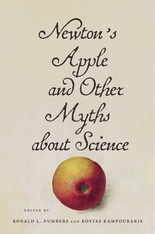
NEWTON'S APPLE AND OTHER MYTHS ABOUT SCIENCE
Ronald L. Numbers Kostas Kampourakis
A falling apple inspired Isaac Newton's insight into the law of gravityor so the story goes. Is it true? Perhaps not. But the more intriguing question is why such stories endure as explanations of how science happens. Newton's Apple and Other Myths about Science brushes away popular misconceptions to provide a clearer picture of great scientific breakthroughs from ancient times to the present.
Among the myths refuted in this volume is the idea that no science was done in the Dark Ages, that alchemy and astrology were purely superstitious pursuits, that fear of public reaction alone led Darwin to delay publishing his theory of evolution, and that Gregor Mendel was far ahead of his time as a pioneer of genetics. Several twentieth-century myths about particle physics, Einstein's theory of relativity, and more are discredited here as well. In addition, a number of broad generalizations about science go under the microscope of history: the notion that religion impeded science, that scientists typically adhere to a codified scientific method, and that a bright line can be drawn between legitimate science and pseudoscience. Edited by Ronald Numbers and Kostas Kampourakis, Newton's Apple and Other Myths about Science debunks the widespread belief that science advances when individual geniuses experience Eureka! moments and suddenly comprehend what those around them could never imagine. Science has always been a cooperative enterprise of dedicated, fallible human beings, for whom context, collaboration, and sheer good luck are the essential elements of discovery. Ronald L. Numbers is Hilldale Professor Emeritus of the History of Science and Medicine at the University of WisconsinMadison. Kostas Kampourakis is Scientific Collaborator in the Section of Biology and at the University Teacher Training Institute, University of Geneva.
| Available products |
|---|
|
Book
Published 2015-11-01 by Harvard University Press |