Skip to content
Responsive image
Vendor
Liepman Literary Agency
Marc Koralnik
Original language
English

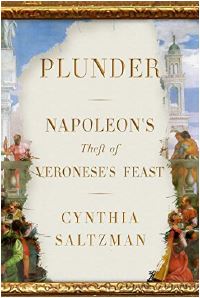
PLUNDER

Cynthia Saltzman

Napoleon's Theft of Veronese's Feast

A captivating in-depth study of Napoleon's plundering of Europe's art and how it legitimized the Louvre.
Vast and sublime, more than twenty-two feet tall and thirty-two feet wide, and featuring a brilliantly staged, lavishly colored banquet with some hundred and thirty figures, Paolo Veronese's painting Wedding Feast at Cana was hailed as a masterpiece of High Renaissance art upon its completion in 1563. It hung in the monastery of the Venetian island of San Giorgio Maggiore until French troops, on the order of their twenty-eight-year-old leader, Napoleon Bonaparte, tore it off the wall of the monastery in 1797. Veronese's masterwork was one of twenty paintings that Napoleon took after his troops marched on Venice. Folded like a rug, the canvas ended up at the Louvre, establishing it as the greatest art museum in the world.

In Plunder: Napoleon's Theft of Veronese's Feast, the celebrated art historian Cynthia Saltzman tells the story of Napoleon's art looting and its relationship to the foundation of the Louvre. As Saltzman shows, Napoleon looted art for the French nation he represented; he displayed it in a public museum, which, owing to the plundered masterworks, soon became the toast of Europe. Napoleon's penchant for looting reflected the best and worst of his character: his desire for greatness—to carry forward the finest parts of civilization—and his ruthlessness in mythologizing himself and seizing power.

Expertly researched, and with rare insight into one of history's most famous and polarizing individuals, Plunder is a propulsive chronicle of the Napoleonic Wars, art theft, and the controversial origins of the world's greatest museum.

CYNTHIA SALTZMAN is the author of OLD MASTERS, NEW WORLD: AMERICA'S RAID ON EUROPE'S GREAT PICTURES and PORTRAIT OF DR. GACHET: THE STORY OF A VAN GOGH MASTERPIECE. The recipient of a Guggenheim fellowship, she selected the letters and wrote an introduction for Vincent van Gogh Lettere, published by Einaudi in its I Millenni series.
Her work has focused on art in the late 19th century—in Europe and America—its creation, acquisition, and migration—its interplay with the economics, politics, and cultural ambitions of that time.
She holds a BA from Harvard University in Fine Arts, an MA from the University of California, at Berkeley, in the History of Art (1975), and an MBA from Stanford University (1977). She lives in New York.
Available products
Book

Published 2021-03-01 by Farrar, Straus & Giroux

Comments

engrossing, tumultuous history of a Renaissance painting Read more...

“Art historian Saltzman (Old Masters, New World) provides a rich account of Napoleon's looting of Italian masterpieces as he battled the Austrian Empire across Italy in the late 18th century. Saltzman focuses on Renaissance artist Paolo Veronese's The Wedding Feast at Cana, a large-format painting depicting the Venetian Republic at the height of its powers, which in Saltzman's view was emblematic of the scale of Napoleon's ambition, both for his military campaigns and the Louvre, where it still hangs. Saltzman unearths fascinating details about the painting, including the contractual terms Veronese agreed to in 1562, his use of ‘the rarest and most costly blue' to paint the sky above the feast, the way it caught the light in the Benedictine refectory where it hung for two centuries until Napoleon plundered it, and the efforts French archivists undertook to keep it out of Nazi hands during WWII. The author's descriptions of Napoleon's military and diplomatic campaigns don't have the same energy and insight as the book's art history. Still, this is a rich and rewarding look at the legacy of wartime art theft and the turbulent life of an Italian masterpiece.”

“Paolo Veronese's Wedding Feast at Cana, completed in 1563 for the refectory at the Monastery of San Giorgio Maggiore in Venice, is now on display in the Louvre's Salle des États across the room from da Vinci's Mona Lisa. This Renaissance masterpiece measures approximately 22-by-33 feet, features 130 life-size figures, and is painted with the finest pigments then available, including an ultramarine made from powdered lapis lazuli. It depicts the New Testament story of Christ's first miracle, turning water into wine at a wedding, and is set at a lavish sixteenth-century banquet. Napoleon's 1797 seizure of this painting was part of a larger campaign in which his troops were ordered to appropriate art from all over Europe, especially Italy, to fill France's recently established national museum of art. Art historian Saltzman's narrative is packed with drama and detail, while an epilogue traces the enormous painting's fate during the nineteenth, twentieth, and twenty-first centuries. With its extensive bibliography and compelling story, Plunder will appeal to everyone interested in Western art and civilization.” —Carolyn Mulac, Booklist

“In this latest work, journalist and author Saltzman (Portrait of Dr. Gachet) explores Napoleon's expropriation of art during his conquests. After a fascinating overview of Venetian artworks, artists, patrons, techniques, and pigments, Saltzman highlights the prized massive masterpiece Wedding Feast at Cana, by Paolo Veronese. Commissioned for the Basilica of San Giorgio Maggiore and completed in 1563, the painting was cut from its home in strips by the conquering French in 1797, then rolled up and shipped to France to be stitched back together. This and other spoils of war formed the basis of the Louvre, which was declared a public museum after the French Revolution introduced the idea that art belongs to the public, not monarchs or the church. Saltzman effectively explains how some artworks were returned to Venice after Napoleon's downfall, though not the Veronese. It remains the largest painting in the Louvre and can be seen in digitized form by anyone with an internet connection. Readers with an interest in art history and those with an interest in stolen art piqued by Anne-Marie O'Connor's The Lady in Gold will appreciate this well-researched and well-written history.” —Laurie Unger Skinner

Thames & Hudson

“In the midst of his Italian campaign, Napoleon Bonaparte stole a painting from a monastery in Venice. Cynthia Saltzman has turned this forgotten episode into a highly original work of history . . . She depicts [Napoleon], with masterly economy, as a brilliant tactician riddled with personal conceits and vanity. The author deftly shifts between Napoleon's military conquests and his wholesale art thefts . . . Saltzman seems equally conversant with 18th-century art criticism and the period's politics . . . Plunder is supported by prodigious research . . . [Saltzman] has written a distinctive study that transcends both art and history and forces us to explore the connections between the two.” —Roger Lowenstein

“How stolen art enriched the Louvre. For Napoleon Bonaparte, artworks represented trophies of military success, might, and power. Prominent among the thousands of pieces his army looted from Italy, Prussia, Austria, and Germany, and displayed with bravado in the Louvre, was Paolo Veronese's Wedding Feast at Cana, ‘a vast, sublime canvas that in 1797 the French tore from a wall of the monastery of San Giorgio Maggiore in Venice.' That Renaissance painting is central to Saltzman's well-researched, discerning history of art as well as the art of war. As Bonaparte rampaged through Europe, he stipulated that ‘artistic indemnities go into the terms of peace,' forcing those he conquered to give up paintings and sculpture ‘as part of the reparations of war.' Even the pope capitulated to Napoleon's demand for 100 artworks from the sumptuous Vatican holdings. Among the extraordinary pieces that Bonaparte plundered, the Veronese was outstanding: ‘a banqueting scene with life-sized figures and an illusion of reality so convincing that the feast appeared to be taking place in the open air.' Saltzman recounts the laborious process of removing the painting, then more than 235 years old, wrapping the stiff canvas around cylinders, transporting it for weeks on shipboard, and, finally, restoring it. ‘To put the canvas up on the wall,' writes the author, restorers ‘would have to build a new stretcher, patch some 360 holes, and retouch these repairs and any other places that had been abraded or left bare.' The project took three years. After Napoleon's military defeats and downfall, nations that had been looted negotiated for the return of their art. The Veronese, though, was not among the repatriated works. Though it was removed from the Louvre several times for safekeeping during wars, it hangs still, testimony to Napoleon's compelling desire to be seen ‘as an Enlightenment leader, an intellectual, and a friend of the philosophes.' An engrossing, tumultuous history of a Renaissance painting.”