| Vendor | |
|---|---|

|
Mohrbooks Literary Agency
Sebastian Ritscher |
| Original language | |
| English | |
| Categories | |
| Weblink | |
| http://www.johanolander.com/ | |
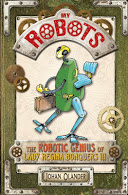
MY ROBOTS
The Robotic Genius of Lady Regina Bonquers III
The never-before-seen collection of some of the most fascinating robots ever made — by an inventor who mysteriously disappeared 40 years ago. The author cleverly fashions himself as the “foremost authority on monsters and aliens”.
Lady Regina Bonquers III was perhaps the world’s greatest robot-maker ever. At one point in time Lady Bonquers was even almost famous, but after several unfortunate incidents that greatly damaged her reputation, she and her work were more or less completely forgotten. She mysteriously disappeared from her Scottish castle in November 1972 and the world might have forgotten all about her. That is, until two years ago, when a trove of sketchbooks, diaries, and notes were discovered in the attic of her abandoned castle by two young relatives, Oscar and Beatrix Bonquers, 9 and 11 years old respectively. The two immediately realized the importance of these papers but were unable to get anyone in media or science interested in their great aunt’s work. Since they were familiar with Monstrologist Johan Olander’s previous scientific work on aliens and monsters, they requested his assistance, which he quickly extended. In MY ROBOTS: The Robotic Genius of Lady Regina Bonquers III, Olander has collected some of the most fascinating robots ever seen and some never before seen, most from Regina’s personal notebooks and research documents. Included are interplanetary battle bots, giant firefighting robots, a pocket-sized personal grooming robot (who will even pluck unwanted nose hairs), and the snuggliest, cuddliest hugging robot ever seen. In the international circle of pseudo-scientists and mad geniuses where Lady Bonquers is still remembered, there have been many theories about her disappearance, whispers of secret government conspiracies, robot uprisings, or even alien intervention. But no one truly knows what happened to Lady Regina, or her robots. But this volume should firmly establish Lady Regina Bonquers III as the unbridled genius she was. Or perhaps still is.
Johan Olander is a freelance journalist, illustrator and photographer. Previous books include RESA TILL NEW YORK, co-written with Olivia Olander and published in 2007 by Ica Bokförlag, in Swedish and Finnish and DETEKTIV I NEW YORK, published in 1999 by LL-Förlaget, Sweden. A FIELD GUIDE TO MONSTERS was his first book in English (Marshall Cavendish, 2007) followed by A FIELD GUIDE TO ALIENS (Marshall Cavendish, 2010). His monsters were displayed as artwork in several museum shows in 2009 including Switzerland’s Zurich Kunsthalle, the Centre Georges Pompidou in Paris, the Irish Museum of Modern Art in Dublin, and at Bard College, New York.
Johan Olander is a freelance journalist, illustrator and photographer. Previous books include RESA TILL NEW YORK, co-written with Olivia Olander and published in 2007 by Ica Bokförlag, in Swedish and Finnish and DETEKTIV I NEW YORK, published in 1999 by LL-Förlaget, Sweden. A FIELD GUIDE TO MONSTERS was his first book in English (Marshall Cavendish, 2007) followed by A FIELD GUIDE TO ALIENS (Marshall Cavendish, 2010). His monsters were displayed as artwork in several museum shows in 2009 including Switzerland’s Zurich Kunsthalle, the Centre Georges Pompidou in Paris, the Irish Museum of Modern Art in Dublin, and at Bard College, New York.
| Available products |
|---|
|
Book
Published by Marshall Cavendish/ Amazon Children's Publishing |
|
Book
Published by Marshall Cavendish/ Amazon Children's Publishing |