| Vendor | |
|---|---|

|
Liepman Literary Agency
Marc Koralnik |
| Original language | |
| English | |
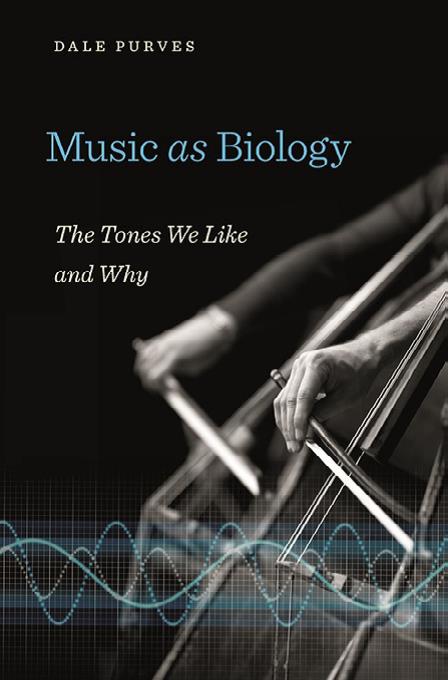
MUSIC AS BIOLOGY. The Tones We Like and Why
An explanation of how musical scales around the world are intricately tied to human biology and evolution.
The universality of musical tones has long fascinated philosophers, scientists, musicians, and ordinary listeners. Why do human beings worldwide find some tone combinations consonant and others dissonant? Why do we make music using only a small number of scales out of the billions that are possible? Why do differently organized scales elicit different emotions? Why are there so few notes in scales? In Music as Biology, Dale Purves argues that biology offers answers to these and other questions on which conventional
music theory is silent.
When people and animals vocalize, they generate tonal soundsperiodic pressure changes at the ear which, when combined, can be heard as melodies and harmonies. Human beings have evolved a sense of tonality, Purves explains, because of the behavioral advantages that arise from recognizing and attending to human voices. The result is subjective responses to tone combinations that are best understood in terms of their
contribution to biological success over evolutionary and individual history. Purves summarizes evidence that the intervals defining Western and other scales are those with the greatest collective similarity to the human voice; that major and minor scales are heard as happy or sad because they mimic the subdued and excited speech of these emotional states; and that the character of a culture's speech influences the tonal palette of its traditional music.
Rethinking music theory in biological terms offers a new approach to centuries-long debates about the organization and impact of music.
Dale Purves is George Barth Geller Professor for Research in Neurobiology Emeritus and presently Research Professor in the Duke Institute for Brain Sciences.
music theory is silent.
When people and animals vocalize, they generate tonal soundsperiodic pressure changes at the ear which, when combined, can be heard as melodies and harmonies. Human beings have evolved a sense of tonality, Purves explains, because of the behavioral advantages that arise from recognizing and attending to human voices. The result is subjective responses to tone combinations that are best understood in terms of their
contribution to biological success over evolutionary and individual history. Purves summarizes evidence that the intervals defining Western and other scales are those with the greatest collective similarity to the human voice; that major and minor scales are heard as happy or sad because they mimic the subdued and excited speech of these emotional states; and that the character of a culture's speech influences the tonal palette of its traditional music.
Rethinking music theory in biological terms offers a new approach to centuries-long debates about the organization and impact of music.
Dale Purves is George Barth Geller Professor for Research in Neurobiology Emeritus and presently Research Professor in the Duke Institute for Brain Sciences.
| Available products |
|---|
|
Book
Published 2017-02-01 by Harvard University Press |