Skip to content
Responsive image
Vendor
Liepman Literary Agency
Marc Koralnik
Original language
English
Categories
Weblink
http://www.richardwagamese.com

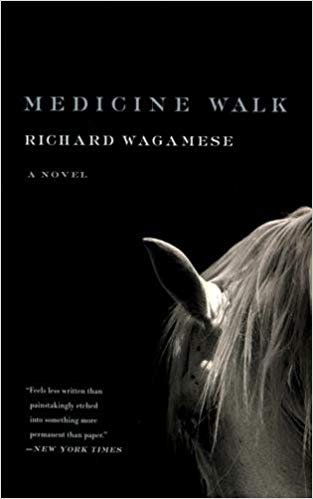
MEDICINE WALK

Richard Wagamese

By turns graphic and gentle, Medicine Walk is a story about displaced fathers and the sons who ache for them. It's a story about love, friendship, courage and the idea that the land has within it powers of healing and communion, if we only take the time to feel them.
Franklin Starlight is called to visit his estranged father, Eldon. He's sixteen years old and has had the most fleeting of relationships with the man. The rare moments they have shared haunt Franklin, but he answers the call, as he feels that is his duty as a son. He finds his father decimated – dying from liver failure with a prostitute in a flophouse. Eldon asks Franklin to take him to the backcountry and bury him in the traditional Ojibway manner – seated facing the east. What ensues is a journey back through time, as the two men push forward to Eldon's end. From a poverty-stricken childhood, to the Korean War, to the derelict houses and alleys of mill towns, Eldon relates the crushing, desolate moments of his life, and the rare moments of bliss he shared with Franklin's luminous mother, and in doing so, offers his son both a connection to a father he never had, and a connection to himself that he never expected. RICHARD WAGAMESE is Ojibway from the Wabaseemoong First Nation in northwest Ontario. A member of the Sturgeon Clan, he is one of Canada's foremost Native authors and journalists. He is the author of five novels, one collection of poetry and three memoirs. His most recent novel, Indian Horse , was published in March 2012 to brilliant reviews (it was called “an unforgettable work of art” in The National Post), and is already on its fourth printing. He lives outside Kamloops BC.
Available products
Book

Published by McClelland & Stewart

Comments

Milkweed Editions

“Not far into Richard Wagamese's “Medicine Walk” — his ninth novel, and one that, given its earnest embrace of legend and myth, feels less written than painstakingly etched into something more permanent than paper — we learn that its young protagonist, an Indian named Franklin Starlight, is a master outdoorsman. Among other things, Frank knows “the value of ammunition. He never wasted a shot. He tracked and waited and bided his time until the animal offered the best possible target. He never rushed.” For Frank, a “hunt was a process.” And so is the way Wagamese pursues his story: biding his time, never rushing, calibrating each word so carefully that he too never seems to waste a shot. But he isn't after the kill. Rather, it's something more complicated — finding a way to honor or at least acknowledge a life ill-lived as it enters its final bitter days Over the course of the book, Wagamese slyly scuffs the idea of what, or who, a good man is Though death saturates these pages, not a word here is lugubrious. Though revelations abound, there are no cheap surprises. “Plain says it plain around here,” the old man cautions Eldon at one point. And yet there's nothing plain about this plain-­spoken book.”

“Award-winning Canadian author Wagamese['s] latest novel unfolds in still, piercing language A soothingly moving novel of rapprochement and family roots for all readers.”

Editions Zoe

“Canadian author and memoirist Wagamese (Indian Horse) has penned a complex, rugged, and moving father-son novel. Wagamese's muscular prose and spare tone complement this gem of a narrative, which examines the bond between father and son.” Read more...

“Wagamese is a keen observer, sketching places ("stars in the thick purple swaddle of the sky") or people ("He leaned when he walked, canted at a hard angle to the right as though gravity worked with different properties on him") elegantly, economically, all while gracefully employing literary insight to deftly dissect blood ties lingering in fractured families A powerful novel of hard men in hard country reminiscent of Jim Harrison's Legends of the Fall” Read more...

“Wagamese's muscular prose and spare tone complement this gem of a narrative.”

"Indian Horse [Wagamese's previous novel] distills much of what Wagamese has been writing about for his whole career into a clearer and sharper liquor, both more bitter and more moving than he has managed in the past. He is such a master of empathy – of delineating the experience of time passing, of lessons being learned, of tragedies being endured – that what Saul discovers becomes something the reader learns, as well, shocking and alien, valuable and true." -- Jane Smiley