| Vendor | |
|---|---|

|
Liepman Literary Agency
Marc Koralnik |
| Original language | |
| French | |
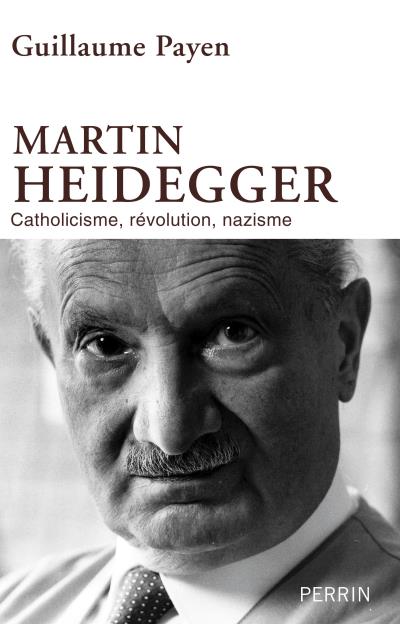
MARTIN HEIDEGGER. Catholicisme, révolution, nazisme
The book's ambition is to present an historical biography of Martin Heidegger. The result of 12 years of research, based on a thorough reading of Heidegger's works, including the controversial Black Notebooks, Guillaume Payen looks at Heidegger's life from the point of view of an historian. A unique biographical contribution.
Many external testimonies, letters written by the philosopher to his wife, his friends, his mistresses, academic lectures, the various texts of commentary or philosophy still in print today, and the Black Notebooks provide the bibliographic database of this biography.
Refusing to take sides, to praise or to vilify, this book attempts to paint an historical portrait of the man, a portrait that is sometimes appealing but often troubling. Heidegger was an attentive reader, a skilled orator who could persuade his interlocutors of the interest, admiration, friendship or love he bore them, but he could also be contemptuous, deceptive, self-centered. He devoted most of his life to lecturing and writing various philosophical texts and many, many letters, yet he did not disdain skiing, canoeing and hiking. While he had little time for his son, he cultivated his great love of women, to the despair of his wife.
Ultimately, the author succeeds in deciphering the three fateful forces that one after the other dominated Heidegger's life: Catholicism, from his youth until the end of the Great War; the revolution, his political and intellectual aspiration until 1933; and as of 1930, Nazism, which for him was the path to be followed for Germany to achieve the philosophical revolution he envisioned.
A professor of history (University of Paris-Sorbonne) and research associate at the Roland Mousnier center (CNRS / Paris-Sorbonne), GUILLAUME PAYEN heads the history division of the research center at the officers' academy of the national Gendarmerie. His work on Martin Heidegger's anti-Semitism was supported by a postdoctoral fellowship from the Foundation for the Memory of the Shoah.
The author is fluent in German.
Refusing to take sides, to praise or to vilify, this book attempts to paint an historical portrait of the man, a portrait that is sometimes appealing but often troubling. Heidegger was an attentive reader, a skilled orator who could persuade his interlocutors of the interest, admiration, friendship or love he bore them, but he could also be contemptuous, deceptive, self-centered. He devoted most of his life to lecturing and writing various philosophical texts and many, many letters, yet he did not disdain skiing, canoeing and hiking. While he had little time for his son, he cultivated his great love of women, to the despair of his wife.
Ultimately, the author succeeds in deciphering the three fateful forces that one after the other dominated Heidegger's life: Catholicism, from his youth until the end of the Great War; the revolution, his political and intellectual aspiration until 1933; and as of 1930, Nazism, which for him was the path to be followed for Germany to achieve the philosophical revolution he envisioned.
A professor of history (University of Paris-Sorbonne) and research associate at the Roland Mousnier center (CNRS / Paris-Sorbonne), GUILLAUME PAYEN heads the history division of the research center at the officers' academy of the national Gendarmerie. His work on Martin Heidegger's anti-Semitism was supported by a postdoctoral fellowship from the Foundation for the Memory of the Shoah.
The author is fluent in German.
| Available products |
|---|
|
Book
Published 2016-01-01 by Perrin |