Skip to content
Responsive image
Vendor
Liepman Literary Agency
Marc Koralnik
Original language
English
Weblink
http://www.hup.harvard.edu/catal …

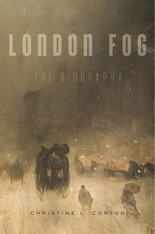
LONDON FOG

Christine L. Corton

The Biography

Corton combines historical and literary sensitivity with an eye for visual drama—generously illustrated here—to reveal London fog as one of the great urban spectacles of the industrial age.
In popular imagination, London is a city of fog. The classic London fogs, the thick yellow “pea-soupers,” were born in the industrial age of the early nineteenth century. The first globally notorious instance of air pollution, they remained a constant feature of cold, windless winter days until clean air legislation in the 1960s brought about their demise. Christine L. Corton tells the story of these epic London fogs, their dangers and beauty, and their lasting effects on our culture and imagination.

As the city grew, smoke from millions of domestic fires, combined with industrial emissions and naturally occurring mists, seeped into homes, shops, and public buildings in dark yellow clouds of water droplets, soot, and sulphur dioxide. The fogs were sometimes so thick that people could not see their own feet. By the time London's fogs lifted in the second half of the twentieth century, they had changed urban life. Fogs had created worlds of anonymity that shaped social relations, providing a cover for crime, and blurring moral and social boundaries. They had been a gift to writers, appearing famously in the works of Charles Dickens, Henry James, Oscar Wilde, Robert Louis Stevenson, Joseph Conrad, and T. S. Eliot. Whistler and Monet painted London fogs with a fascination other artists reserved for the clear light of the Mediterranean.

Christine L. Corton is a Senior Member of Wolfson College, Cambridge, and a freelance writer. She worked for many years at publishing houses in London.
Available products
Book

Published 2015-11-01 by Harvard University Press

Comments

“An intriguing biography of the weather effect that defined a national character An eye-opening and highly readable picture of London's reactions to the killer fog that has characterized it for centuries.”—Kirkus Reviews

“The sheer scale of the pollution described by Corton is hard to grasp Corton leads the way, like a linklighter of old, through the poisonous clouds of times gone by, and arrives, eventually, at present day Oxford Street, where nitrogen dioxide concentrations are ‘worse than they are anywhere on earth.'”—Charlie Gilmour, The Independent on Sunday

“[An] engrossing book This book could almost make one nostalgic for the days of the pea souper were it not for the fact that it was clearly a terrible threat to health.”—Daisy Goodwin, The Times

“The idea of a biography of fog in London might initially appear a doubtful enterprise, but in Christine Corton's capable hands it works brilliantly. The liveliness of metropolitan fog is beautifully charted here in a long chronology from the Stuart era to the Clean Air Acts of the 1950s to 1990s [A] most extraordinarily rich collection of material from scientific, journalistic, literary, humorous, artistic and medical sources She has created a history of fog's material and immaterial culture The text is interspersed with some astonishing visual material, appropriately placed, making the book a visual feast especially of little-known artworks, caricatures and photographs of great beauty. Corton's use of the perceptions of foreign visitors, especially those from China and Japan, is revelatory London Fog is not just a literary exercise; it also charts the long trajectory of a deeply serious public health matter that we have yet to confront, as we should, once again This fine book has real substance, generously shared, and is very timely indeed.”—Ruth Richardson, Times Higher Education

“Corton's eye for social history is superb. We are led with wit and intelligence through a London in which clerks in counting-houses are forbidden to leave their books lying open lest the sooty fogs blacken the pages Corton is excellent on the extent to which, in the twentieth century and since, the close association between Victorian London and Gothic fog has clouded perceptions of Victorian life and art.”—Richard Smyth, The Times Literary Supplement

“Christine Corton takes a subject that is now scarcely more than a heritage item—like gaslight and hansom cabs—and puts it where it belongs among the great public-health movements of the 19th and 20th centuries Of course, fog was not solely a public-health problem. With the help of wonderful contemporary illustrations, Corton vividly describes the chaos it brought—pedestrians groping, traffic crawling, accidents, crime and drunkenness soaring. The melting, blurring, looming transformations of fog seemed to symbolize the dissolution of society itself. Writers saw the possibilities, and Corton pursues their metaphorical fogs through every kind of moral, psychological and social disintegration. Charles Dickens, Henry James, Joseph Conrad, Robert Louis Stevenson, all are here—plus a mass of fascinating and forgotten popular literature—their cultural meanings perceptively analyzed This is a rich and multifaceted book.”—The Economist

“Corton undertakes a definitive study of London's ‘pea-souper' fogs, deftly tracing the history of a weather condition that became a defining feature of the city in the world's imagination. As Corton shows, the fog, which first appeared early in the 19th century, proved a ready metaphor for an array of Victorian anxieties, from Jack the Ripper's reign of terror to a perceived decline in public morals. She perceptively examines the literary manifestations of these fears in chapters covering a number of famous authors, including Charles Dickens, Robert Louis Stevenson, and T.S. Eliot. Readers may be surprised that the history of London fog requires a detour through the politics of the day as much as through literature; however, Corton proves a sensible guide through the labyrinthine parliamentary measures arising from public outrage over the ‘great killer fog' and bureaucratic inaction in service of the manufacturers that were largely responsible for the pollution. Though the ‘London particular' was finally legislated out of existence in the 1960s, Corton asserts convincingly that the fog will remain enshrined in cultural memory, a romantic if no longer accurate symbol of a great city.”—Publishers Weekly

“A thoroughly researched and generally enjoyable account of the social, natural and cultural history of the peasoupers, from their first appearance in the early 1800s to the final fog of 1962.”—David B. Williams, The Seattle Times

“Brilliant Corton has a deft historical, literary and visual eye. While tracing the birth, maturity and death of fog, she pays careful attention to the ways it affected everyday lives and locations But her real interest is in the way fog played in the imagination. For centuries, she shows, novelists, essayists, cartoonists and painters used fog as a metaphor for human relationships and the moral order Corton's book is an unsentimental and elegant reflection on a world that has passed.”—Joanna Bourke, The Daily Telegraph

“Corton's wonderfully detailed and original exploration of foggy London ranges from the earliest mists to the last great pea-souper of 1962 Her account is rich in memorable anecdotes and descriptions, gleaned from popular culture, literature, journals and contemporary letters as well as cartoons and art history: the book is also splendidly illustrated.”—P. D. Smith, The Guardian

“London's ‘pea-soupers'—opaque, yellowish smogs—were an environmental catastrophe, a cloak for nefarious activities and an artistic inspiration. An odiferous wig of soot from coal fires, sulfur dioxide and mist settled regularly over the city from the 1840s to the 1960s. In this richly nuanced history, scholar Christine Corton takes us from polymath Robert Hooke spotting a pall of smoke over London in 1676 through the killer fogs that felled zoo animals, spurred crime and caused traffic accidents, and that ultimately galvanized scientists and the government to craft the 1956 Clean Air Act.”—Barbara Kiser, Nature

“Christine Corton's excellent book explores three questions: how people accounted for London fog, what they did about it, and how it became such an enormous, apparently inexhaustible cultural resource and metaphor Corton has assembled an astonishing display of fog fiction Corton has written a thoughtful, vivid, very memorable book.”—Neal Ascherson, London Review of Books

“In London Fog, Christine L. Corton guides us through the history of the ‘pea-souper' (the phrase first used in print in 1849 by Herman Melville); from Victorian women, fearful of attack in the impenetrable murk, to the poets, artists and film-makers who thrived on its metaphorical potential; from the political rows over domestic coal fires to the dreadful 1952 Great Smog which claimed thousands of lives and was so thick that, even indoors, office workers could not see to the end of the corridor.”—Sinclair McKay, The Daily Telegraph

“[Corton's] fascinating history traces London's unique brand of photochemical smog from its surprisingly early birth in the 13th century, when complaints about the burning of ‘sea coal' in London hearths began, through its malign maturity in the 19th, to its death throes in the second half of the 20th The many well-chosen images in London Fog include works by minor painters of London scenes and by various illustrators, photojournalists and cartoonists playing on the terror, confusion and comedy caused by fog. These add greatly to the interest of Corton's book.”—Catherine Peters, Literary Review

“Engrossing and magnificently researched Corton's book combines meticulous social history with a wealth of eccentric detail. Thus we learn that London's ubiquitous plane trees were chosen for their shiny, fog-resistant foliage. And since Jack the Ripper actually went out to stalk his victims on fog-free nights, filmmakers had to fake the sort of dank, smoke-wreathed London scenes audiences craved. It's discoveries like these that make reading London Fog such an unusual, enthralling and enlightening experience.”—Miranda Seymour, The New York Times Book Review