| Vendor | |
|---|---|

|
Mohrbooks Literary Agency
Sebastian Ritscher |
| Original language | |
| English | |
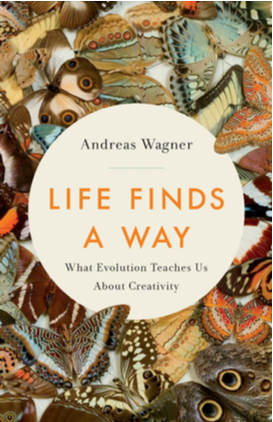
LIFE FINDS A WAY
What Evolution Teaches Us About Creativity
How the principles of biological innovation can help us overcome creative challenges in art, business, and science.
In Life Finds a Way, biologist Andreas Wagner reveals the deep symmetry between innovation in biological evolution and human cultural creativity. Rarely is either a linear climb to perfection--instead, "progress" is typically marked by a sequence of peaks, plateaus, and pitfalls. For instance, in Picasso's forty-some iterations of Guernica, we see the same combination of small steps, incessant reshuffling, and large, almost reckless, leaps that characterize the way evolution transformed a dinosaur's grasping claw into a condor's soaring wing. By understanding these principles, we can also better realize our own creative potential to find new solutions to adversity.
Ultimately, Life Finds a Way offers a new framework for the nature of creativity, enabling us to better adapt, grow, and change in art, business, or science--that is, in life.
Andreas Wagner is a professor and chairman at the Department of Evolutionary Biology and Environmental Studies at the University of Zürich and an External Professor for the study of complex systems at the Sante Fe Institute. He is the author of four books on evolutionary innovation and has published nearly 200 scientific papers (in Nature and Science, among other popular science outlets and journals), and his work has been cited over 13,000 times. He received a PhD in evolutionary biology from Yale. A dual Austrian-American citizen, he lives in Zurich, Switzerland.
Ultimately, Life Finds a Way offers a new framework for the nature of creativity, enabling us to better adapt, grow, and change in art, business, or science--that is, in life.
Andreas Wagner is a professor and chairman at the Department of Evolutionary Biology and Environmental Studies at the University of Zürich and an External Professor for the study of complex systems at the Sante Fe Institute. He is the author of four books on evolutionary innovation and has published nearly 200 scientific papers (in Nature and Science, among other popular science outlets and journals), and his work has been cited over 13,000 times. He received a PhD in evolutionary biology from Yale. A dual Austrian-American citizen, he lives in Zurich, Switzerland.
| Available products |
|---|
|
Book
Published 2019-06-01 by Basic Books |