| Vendor | |
|---|---|

|
Mohrbooks Literary Agency
Sebastian Ritscher |
| Original language | |
| English | |
| Categories | |
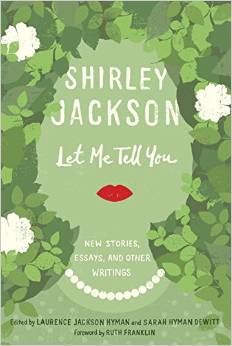
LET ME TELL YOU
Sarah Hyman DeWitt Laurence Jackson Hyman Shirley Jackson
New Stories, Essays, and Other Writings
Shirley Jackson is one of the most important American writers of the last hundred years. Since her death in 1965, her place in the landscape of twentieth-century fiction has grown only more exalted. Let Me Tell You brings together the deliciously eerie short stories Jackson is best known for, along with frank, inspiring lectures on writing; comic essays about her large, boisterous family; and whimsical drawings.
Shirley Jackson is one of the most important American writers of the last hundred years. Since her death in 1965, her place in the landscape of twentieth-century fiction has grown only more exalted.
As we approach the centenary of her birth comes this astonishing compilation of fifty-six pieces—more than forty of which have never been published before. Two of Jackson’s children co-edited this volume, culling through the vast archives of their mother’s papers at the Library of Congress, selecting only the very best for inclusion.
Let Me Tell You brings together the deliciously eerie short stories Jackson is best known for, along with frank, inspiring lectures on writing; comic essays about her large, boisterous family; and whimsical drawings. Jackson’s landscape here is most frequently domestic: dinner parties and bridge, household budgets and homeward-bound commutes, children’s games and neighborly gossip. But this familiar setting is also her most subversive: She wields humor, terror, and the uncanny to explore the real challenges of marriage, parenting, and community—the pressure of social norms, the veins of distrust in love, the constant lack of time and space.
For the first time, this collection showcases Shirley Jackson’s radically different modes of writing side by side. Together they show her to be a magnificent storyteller, a sharp, sly humorist, and a powerful feminist.
This volume includes a Foreword by the celebrated literary critic and Jackson biographer Ruth Franklin.
Shirley Jackson was born in San Francisco on December 14, 1916. She first received wide critical acclaim for “The Lottery,” which was published in The New Yorker in 1948 and went on to become one of the most anthologized stories in American literature. She is the author of six novels, including The Haunting of Hill House and We Have Always Lived in the Castle; four collections of short stories and essays, including Just an Ordinary Day; and two family memoirs, Life Among the Savages and Raising Demons. For many years she lived in North Bennington, Vermont, with her husband, the renowned literary critic Stanley Edgar Hyman, and their four children. She died on August 8, 1965.
Laurence Jackson Hyman, the eldest child of Shirley Jackson and Stanley Edgar Hyman, has spent most of his professional life in publishing: as writer, photographer, editor, art director, and publisher. He is the author, editor, or co-editor of dozens of books and monographs.
Sarah Hyman DeWitt is the third child of Shirley Jackson and Stanley Edgar Hyman. She is a performer, folksinger, and artist.
Ruth Franklin is a book critic and the author of A Thousand Darknesses, which was a finalist for the 2012 Sami Rohr Prize for Jewish Literature. She has written for many publications, including The New Republic, The New Yorker, The New York Review of Books, The New York Times Magazine, Bookforum, and Granta. She is at work on a biography of Shirley Jackson.
As we approach the centenary of her birth comes this astonishing compilation of fifty-six pieces—more than forty of which have never been published before. Two of Jackson’s children co-edited this volume, culling through the vast archives of their mother’s papers at the Library of Congress, selecting only the very best for inclusion.
Let Me Tell You brings together the deliciously eerie short stories Jackson is best known for, along with frank, inspiring lectures on writing; comic essays about her large, boisterous family; and whimsical drawings. Jackson’s landscape here is most frequently domestic: dinner parties and bridge, household budgets and homeward-bound commutes, children’s games and neighborly gossip. But this familiar setting is also her most subversive: She wields humor, terror, and the uncanny to explore the real challenges of marriage, parenting, and community—the pressure of social norms, the veins of distrust in love, the constant lack of time and space.
For the first time, this collection showcases Shirley Jackson’s radically different modes of writing side by side. Together they show her to be a magnificent storyteller, a sharp, sly humorist, and a powerful feminist.
This volume includes a Foreword by the celebrated literary critic and Jackson biographer Ruth Franklin.
Shirley Jackson was born in San Francisco on December 14, 1916. She first received wide critical acclaim for “The Lottery,” which was published in The New Yorker in 1948 and went on to become one of the most anthologized stories in American literature. She is the author of six novels, including The Haunting of Hill House and We Have Always Lived in the Castle; four collections of short stories and essays, including Just an Ordinary Day; and two family memoirs, Life Among the Savages and Raising Demons. For many years she lived in North Bennington, Vermont, with her husband, the renowned literary critic Stanley Edgar Hyman, and their four children. She died on August 8, 1965.
Laurence Jackson Hyman, the eldest child of Shirley Jackson and Stanley Edgar Hyman, has spent most of his professional life in publishing: as writer, photographer, editor, art director, and publisher. He is the author, editor, or co-editor of dozens of books and monographs.
Sarah Hyman DeWitt is the third child of Shirley Jackson and Stanley Edgar Hyman. She is a performer, folksinger, and artist.
Ruth Franklin is a book critic and the author of A Thousand Darknesses, which was a finalist for the 2012 Sami Rohr Prize for Jewish Literature. She has written for many publications, including The New Republic, The New Yorker, The New York Review of Books, The New York Times Magazine, Bookforum, and Granta. She is at work on a biography of Shirley Jackson.
| Available products |
|---|
|
Book
Published 2015-08-01 by Random House |
|
Book
Published 2015-08-01 by Random House |