| Vendor | |
|---|---|

|
Liepman Literary Agency
Marc Koralnik |
| Original language | |
| French | |
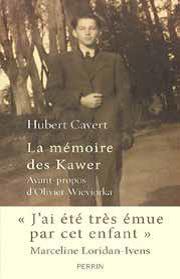
LA MÉMOIRE DES KAWER
The testimony of an orphan caught up in the turmoil of World War II.
An incredibly powerful story, in which history is mixed inextricably with personal anecdote. It answers the judicious question Olivier Wieviorka asks in his foreword: Are men the actors or victims of history of their own history?
Herbert Kawer was 11 years old when he left Vienna by train, alone, to join his father in Bordeaux. His father, a Jew, had taken refuge in France after the Anschluss and would eventually be deported. Little Herbert would never see him again, or his mother, who had gone to start a new life in England. Escaping capture by chance, Herbert was taken in by the headmaster of his school and then by a resistance network. He was put in the care of Marinette Brugat (called Marraine) and Palmire, a Spanish refugee with whom she lived. Herbert, now named Hubert, thus began his new life in Pia, in the Pyrénées-Orientales region of southern France.
Hubert Cavert had never told his story or his family's. It was only on the eve of his death that he entrusted a manuscript to his children. Going beyond his personal journey, it traces the history of the Kawer (Cavert) family from 1866 hallowed period when Joseph II had made Jews and Christians equal citizens until 1945. We see customs and traditions change, as time rushes. We follow the course of history through this little boy who carries with him his inheritance. As an adult, his message is simple: As you know, I married Edith on April 15, 1958. We started a family of which we are proud. Foolishly proud. We are happy. Be happy too.
HUBERT CAVERT (born Herbert Kawer) is neither a writer nor a historian. At the end of the war, he had no family left in Austria. He acquired French citizenship and began his secondary education at the Lycée Pierre de Fermat in Toulouse before taking up engineering in Nancy. He went on to hold various posts at the Radiotechnique Francaise, Honeywell and Banexi, a subsidiary of the BNP bank. Father of three children, he never told them his story but left this manuscript, the only trace of their past, as their legacy.
Herbert Kawer was 11 years old when he left Vienna by train, alone, to join his father in Bordeaux. His father, a Jew, had taken refuge in France after the Anschluss and would eventually be deported. Little Herbert would never see him again, or his mother, who had gone to start a new life in England. Escaping capture by chance, Herbert was taken in by the headmaster of his school and then by a resistance network. He was put in the care of Marinette Brugat (called Marraine) and Palmire, a Spanish refugee with whom she lived. Herbert, now named Hubert, thus began his new life in Pia, in the Pyrénées-Orientales region of southern France.
Hubert Cavert had never told his story or his family's. It was only on the eve of his death that he entrusted a manuscript to his children. Going beyond his personal journey, it traces the history of the Kawer (Cavert) family from 1866 hallowed period when Joseph II had made Jews and Christians equal citizens until 1945. We see customs and traditions change, as time rushes. We follow the course of history through this little boy who carries with him his inheritance. As an adult, his message is simple: As you know, I married Edith on April 15, 1958. We started a family of which we are proud. Foolishly proud. We are happy. Be happy too.
HUBERT CAVERT (born Herbert Kawer) is neither a writer nor a historian. At the end of the war, he had no family left in Austria. He acquired French citizenship and began his secondary education at the Lycée Pierre de Fermat in Toulouse before taking up engineering in Nancy. He went on to hold various posts at the Radiotechnique Francaise, Honeywell and Banexi, a subsidiary of the BNP bank. Father of three children, he never told them his story but left this manuscript, the only trace of their past, as their legacy.
| Available products |
|---|
|
Book
Published 2017-02-01 by Perrin |