| Vendor | |
|---|---|

|
Mohrbooks Literary Agency
Sebastian Ritscher |
| Original language | |
| English | |
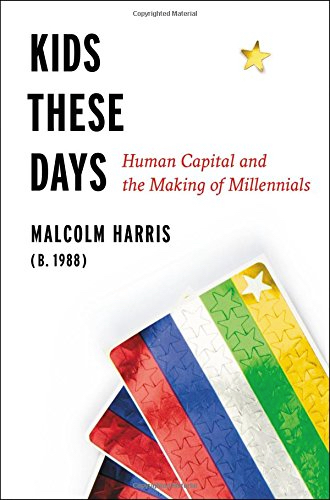
KIDS THESE DAYS
Human Capital and the Making of Millenials
Being a 20-something in the world, today, is harder than ever. Malcolm Harris knows this from personal experience. Born into a generation that has been called “lazy, entitled, selfish, and shallow” (Joel Stein inTIME, 2013), Harris instead sees his fellow millenials as products of a winner-take-all system that has molded his peers intohyper-efficient, hyper-competitive, low-cost labor machines.
Far from being lazy, millennials, who grew up with an unprecedented lack of unsupervised time, have been giving away free labor since childhood, to institutions that have shifted the costs of human capital development onto students and workers. They worked on homework, sports, extracurriculars, went into crippling debt to keep working in college, then entered the job market to compete fiercely for the privilege of giving away more free work to employers (internships).
Harris merges economics and the pop signifiers of the past 40 years into a stream of social criticism - “the pedagogical mask” and the Spice Girls, the student debt industry and the birth of the “tween,” mass incarceration and Miley Cyrus.
This is a serious, data-driven look at what it means to be young. ALL THAT WORK FOR NOTHING challenges stereotypes and puts forth a new hypothesis: that Millenials are the most valuable human capital the world has ever seen, and they won’t be sharing in the surplus they have been molded to create.
Malcolm Harris is a columnist for Pacific Standard and an Editor of The New Inquiry. His work has appeared in The New Republic, Bookforum, the Village Voice, and The New York Times Magazine.
Harris merges economics and the pop signifiers of the past 40 years into a stream of social criticism - “the pedagogical mask” and the Spice Girls, the student debt industry and the birth of the “tween,” mass incarceration and Miley Cyrus.
This is a serious, data-driven look at what it means to be young. ALL THAT WORK FOR NOTHING challenges stereotypes and puts forth a new hypothesis: that Millenials are the most valuable human capital the world has ever seen, and they won’t be sharing in the surplus they have been molded to create.
Malcolm Harris is a columnist for Pacific Standard and an Editor of The New Inquiry. His work has appeared in The New Republic, Bookforum, the Village Voice, and The New York Times Magazine.
| Available products |
|---|
|
Book
Published 2017-11-07 by Little Brown |
|
Book
Published 2017-11-07 by Little Brown |