| Vendor | |
|---|---|

|
Fritz Agency
Christian Dittus |
| Original language | |
| English | |
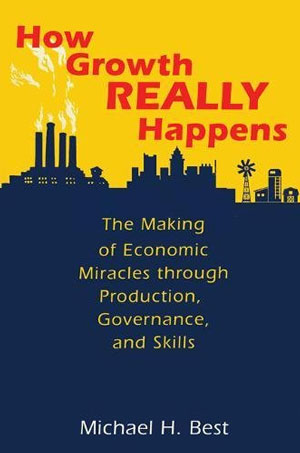
HOW GROWTH REALLY HAPPENS
The Making of Economic Miracles Through Production, Governance, and Skills
A groundbreaking study that shows how countries can create innovative, production-based economies for the twenty-first century.
This production-centric framework is the culmination of three simultaneous journeys. The first has been Best's visits to hundreds of factories worldwide, starting early as the son of a labor organizer and continuing through his work as an academic and industrial consultant. The second is a survey of two-hundred years of economic thought from Babbage to Krugman, with stops along the way for Marx, Marshall, Young, Penrose, Richardson, Schumpeter, Kuznets, Abramovitz, Keynes, and Jacobs. The third is a tour of historical episodes of successful and failed transformations, focusing sharply on three core elements--the production system, business organization, and skill formation?and their interconnections.
Best makes the case that government should create the institutional infrastructures needed to support these elements and their interconnections rather than subsidize individual enterprises. The power of Best's alternative framework is illustrated by case studies of transformative experiences previously regarded as economic "miracles": America's World War II industrial buildup, Germany's postwar recovery, Greater Boston's innovation system, Ireland's tech-sector boom, and the rise of the Asian Tigers and China.
Michael H. Best is professor emeritus of economics at the University of Massachusetts, Lowell, where he was codirector of the Center for Industrial Competitiveness. He has held numerous academic fellowships and participated in development projects with the United Nations, the World Bank, and governments in more than twenty countries.
This production-centric framework is the culmination of three simultaneous journeys. The first has been Best's visits to hundreds of factories worldwide, starting early as the son of a labor organizer and continuing through his work as an academic and industrial consultant. The second is a survey of two-hundred years of economic thought from Babbage to Krugman, with stops along the way for Marx, Marshall, Young, Penrose, Richardson, Schumpeter, Kuznets, Abramovitz, Keynes, and Jacobs. The third is a tour of historical episodes of successful and failed transformations, focusing sharply on three core elements--the production system, business organization, and skill formation?and their interconnections.
Best makes the case that government should create the institutional infrastructures needed to support these elements and their interconnections rather than subsidize individual enterprises. The power of Best's alternative framework is illustrated by case studies of transformative experiences previously regarded as economic "miracles": America's World War II industrial buildup, Germany's postwar recovery, Greater Boston's innovation system, Ireland's tech-sector boom, and the rise of the Asian Tigers and China.
Michael H. Best is professor emeritus of economics at the University of Massachusetts, Lowell, where he was codirector of the Center for Industrial Competitiveness. He has held numerous academic fellowships and participated in development projects with the United Nations, the World Bank, and governments in more than twenty countries.
| Available products |
|---|
|
Book
Published 2018-06-01 by Princeton University Press |