| Vendor | |
|---|---|

|
Mohrbooks Literary Agency
Sebastian Ritscher |
| Original language | |
| English | |
| Categories | |
| Weblink | |
| http://books.simonandschuster.co … | |
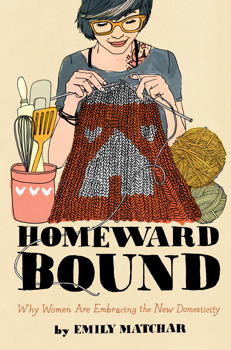
HOMEWARD BOUND
Why Women are Embracing the New Domesticity
Call it New Domesticity, New Victorianism, Generation DIY. One thing's clear: traditional homemaking skills like cheese making, sweater knitting, and home gardening are in the midst of a major comeback. And high-achieving young women are leading the way. In Homeward bound, Emily Matchar offers a smart, measured investigation into the cultural, social and economic implications of this return to domesticity.
What happens to our society as a whole when smart, high-achieving young women are honing their traditional homemaking skills? Emily Matchar offers a sharp investigation into this startling trend.
There‘s no doubt about it, domesticity is enjoying a major comeback, with the explosion of“stitch n‘ bitch“ knitting circles, our sudden fascination with canning, cheese-making, and grinding our own flour, a rise in DIY parenting that embraces closeness but eschews medical authority and statistics, and a tidal wave of memoirs in the “I quit my corporatejob and found fulfiliment on a Vermont goat farm“ vein. Why are wornen—and more than a few men—embracing the labor-intense domestic tasks that our mothers and grandmothers so eagerly shrugged off? Why has the image of the blissfully domestic, vintage-clad supermom become the media‘s feminine ideal?
In Horneward Bound, Emily Matchar offers an investigation into how New Domesticity is fundamentally reshaping the roIe of women in society, and what the consequences might be. With research spanning from coast to coast, Matchar introduces us to a diverse cast o fcharacters Southern food bloggers, “radical homemakers“ on the East Coast, Etsy entrepreneurs in Provo, members of urban knitting circies in Austin, and many more. She examines the far-tanging consequences oft his trend, and what it means for women, for men, for families, and for society at large.
Emily Matchar writes about culture, women‘s issues, work, food and more for places such as The Atlantc, The Washington Post, Salon, The Hairpin, Gourrnet, Men‘s Journal, Outside and many others. She lives in Hong Kong and Chapel Hill, North Carolina with her husband.
There‘s no doubt about it, domesticity is enjoying a major comeback, with the explosion of“stitch n‘ bitch“ knitting circles, our sudden fascination with canning, cheese-making, and grinding our own flour, a rise in DIY parenting that embraces closeness but eschews medical authority and statistics, and a tidal wave of memoirs in the “I quit my corporatejob and found fulfiliment on a Vermont goat farm“ vein. Why are wornen—and more than a few men—embracing the labor-intense domestic tasks that our mothers and grandmothers so eagerly shrugged off? Why has the image of the blissfully domestic, vintage-clad supermom become the media‘s feminine ideal?
In Horneward Bound, Emily Matchar offers an investigation into how New Domesticity is fundamentally reshaping the roIe of women in society, and what the consequences might be. With research spanning from coast to coast, Matchar introduces us to a diverse cast o fcharacters Southern food bloggers, “radical homemakers“ on the East Coast, Etsy entrepreneurs in Provo, members of urban knitting circies in Austin, and many more. She examines the far-tanging consequences oft his trend, and what it means for women, for men, for families, and for society at large.
Emily Matchar writes about culture, women‘s issues, work, food and more for places such as The Atlantc, The Washington Post, Salon, The Hairpin, Gourrnet, Men‘s Journal, Outside and many others. She lives in Hong Kong and Chapel Hill, North Carolina with her husband.
| Available products |
|---|
|
Book
Published 2013-05-01 by Simon & Schuster |
|
Book
Published 2013-05-01 by Simon & Schuster |