| Vendor | |
|---|---|

|
Mohrbooks Literary Agency
Sebastian Ritscher |
| Original language | |
| English | |
| Categories | |
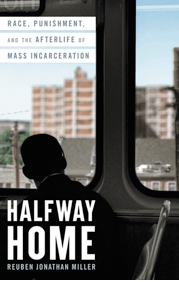
HALFWAY HOME
Race, Punishment, and the Afterlife of Mass Incarceration
A remarkable work of scholarship and reportage by a noted sociologist that will forever change how we look at life after prison.
Each year, more than half a million Americans are released from prison and join a population of twenty million people who must live with a felony record.
Reuben Miller, a chaplain at the Cook County Jail in Chicago and later a sociologist studying mass incarceration, spent years alongside prisoners, ex-prisoners, their friends, and their families to understand the lifelong burden that a single arrest can entail. What his work revealed is a simple, if overlooked truth: life after incarceration is its own form of prison. The idea that one can serve their debt and return to life as a full-fledge member of society is one of America's most nefarious myths. Recently released individuals are faced with the new reality of jobs that are off-limits, apartments that cannot be occupied and votes that cannot be cast. Homelessness and poverty are the chief features of life after prison.
As The Color of Law exposed about our understanding of housing segregation, Halfway Home shows that the American justice system was not created to rehabilitate, but is in fact structured to keep a particular class of people impoverished, unstable, and disenfranchised long after they've paid their debt to society.
This invaluable work of scholarship, deftly informed by Miller's experience as the son and brother of incarcerated men, captures the stories of the men, women, and communities fighting against a system that is designed for them to fail. It is a poignant and eye-opening call to arms that reveals how laws, rules, and regulations extract a tangible cost not only from those working to rebuild their lives, but also our democracy. As Miller searchingly writes, America must acknowledge and value the lives of its formerly imprisoned citizens.
Reuben Jonathan Miller is a sociologist, criminologist and a social worker who teaches at the University of Chicago in the School of Social Service Administration where he studies and writes about race, democracy, and the social life of the city. He has been a member at the Institute for Advanced Study in Princeton New Jersey, a fellow at the New America Foundation and the Rockefeller Foundation, and a visiting scholar at the University of Texas at Austin and Dartmouth College. A native son of Chicago, he lives with his wife and children on the city's southside.
Reuben Miller, a chaplain at the Cook County Jail in Chicago and later a sociologist studying mass incarceration, spent years alongside prisoners, ex-prisoners, their friends, and their families to understand the lifelong burden that a single arrest can entail. What his work revealed is a simple, if overlooked truth: life after incarceration is its own form of prison. The idea that one can serve their debt and return to life as a full-fledge member of society is one of America's most nefarious myths. Recently released individuals are faced with the new reality of jobs that are off-limits, apartments that cannot be occupied and votes that cannot be cast. Homelessness and poverty are the chief features of life after prison.
As The Color of Law exposed about our understanding of housing segregation, Halfway Home shows that the American justice system was not created to rehabilitate, but is in fact structured to keep a particular class of people impoverished, unstable, and disenfranchised long after they've paid their debt to society.
This invaluable work of scholarship, deftly informed by Miller's experience as the son and brother of incarcerated men, captures the stories of the men, women, and communities fighting against a system that is designed for them to fail. It is a poignant and eye-opening call to arms that reveals how laws, rules, and regulations extract a tangible cost not only from those working to rebuild their lives, but also our democracy. As Miller searchingly writes, America must acknowledge and value the lives of its formerly imprisoned citizens.
Reuben Jonathan Miller is a sociologist, criminologist and a social worker who teaches at the University of Chicago in the School of Social Service Administration where he studies and writes about race, democracy, and the social life of the city. He has been a member at the Institute for Advanced Study in Princeton New Jersey, a fellow at the New America Foundation and the Rockefeller Foundation, and a visiting scholar at the University of Texas at Austin and Dartmouth College. A native son of Chicago, he lives with his wife and children on the city's southside.
| Available products |
|---|
|
Book
Published 2021-02-02 by Little Brown |