| Vendor | |
|---|---|

|
Mohrbooks Literary Agency
Sebastian Ritscher |
| Original language | |
| English | |
| Categories | |
| Weblink | |
| http://catalog.simonandschuster. … | |
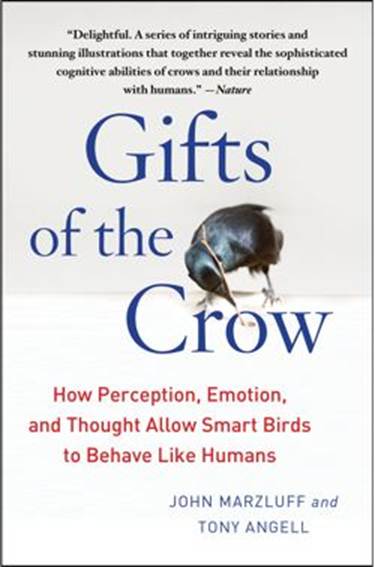
GIFTS OF THE CROW
How Perception, Emotion, and Thought Allow Smart Birds to Behave Like Humans
An absolutely astonishing look at the almost-human personalities and intelligence of crows, written by the preeminent researcher on these smart, sassy, talkative, vengeful, self-aware, "bad," playful--and gift-giving--birds.
Members of the bird group, the family Corvidae or “corvids” for short, are among the most intelligent of all birds. Their brains are huge for their body size. In fact, they are of a size more consistent with that of a small monkey rather than a bird. And because these birds often live near people—in our gardens, parks, and cities—they are keenly aware of our peculiarities. They quickly learn to recognize and approach those who care for and feed them. And to stay away from or even scold those people who threaten or harm them. This is an important, learned skill that enables corvids to exploit friendly humans and avoid dangerous ones.
As scientist and artist that specialize in studying, and interpreting crows (birds of the corvid family, including crows, ravens, jays, and their relatives), Marzluff and Angell are often startled by their research findings, and the incredible stories they hear. Crows have funerals, warn of impending doom, use vending machines, recognize people, commit murder, lure fish and birds to their death, drink beer, turn on lights to stay warm, design and use tools, use cars as nutcrackers, play with cats, and work in tandem to get cheese whiz out of a can. Some of these tales are well documented. Most are plausible, if incredible.
Crows and ravens are particularly adept at responding to environmental challenges including those posed by humans because long lives, social lifestyles, and large brains allow them to observe and learn from our social gatherings--redefining the notion of “bird brain.” Their individual and collective social learning abilities enable them to craft tools, communicate subtle messages, plan for the future, use insight, deceive, and carefully adjust their boisterous life to our unpredictable nature. All of these anecdotes are interesting examples of an ongoing connection—what we call a cultural coevolution—that has shaped humans and crows for millions of years. But what is it about crows that the deer, the sparrow, or the bear lacks? It is the language, delinquency, insight, frolic, passion, wrath, risk taking, and awareness of crows that demand we pay them attention. The book is divided into these seven chapters of crow behavior that most reflects our symbiotic relationship with crows. The amazing behavior of these common and accessible animals causes us to pause; and wonder.
John Marzluff is Professor of Wildlife Science at the University of Washington. His research has been the focus of articles in the New York Times, National Geographic, Audubon, Boys Life, The Seattle Times, and National Wildlife. PBS’s NATURE featured his raven research in its 2001 production "Ravens," and featured his crow research in 2010 with the film documentary, "A Murder of Crows." His graduate and initial postdoctora research focused on the social behavior and ecology of jays and ravens. He has authored over 100 scientific papers on various aspects of bird behavior and wildlife management in addition to the four books he's written.
Tony Angell has authored and or illustrated a dozen award-winning books related to natural history. Most recently, his drawings in the coauthored book, In the Company of Crows and Ravens, received the prestigious Victoria/Albert prize. Angell’s art work also includes both stone and bronze sculpture which are the basis for his one man shows and retrospectives that he has regularly had over the past forty years.
As scientist and artist that specialize in studying, and interpreting crows (birds of the corvid family, including crows, ravens, jays, and their relatives), Marzluff and Angell are often startled by their research findings, and the incredible stories they hear. Crows have funerals, warn of impending doom, use vending machines, recognize people, commit murder, lure fish and birds to their death, drink beer, turn on lights to stay warm, design and use tools, use cars as nutcrackers, play with cats, and work in tandem to get cheese whiz out of a can. Some of these tales are well documented. Most are plausible, if incredible.
Crows and ravens are particularly adept at responding to environmental challenges including those posed by humans because long lives, social lifestyles, and large brains allow them to observe and learn from our social gatherings--redefining the notion of “bird brain.” Their individual and collective social learning abilities enable them to craft tools, communicate subtle messages, plan for the future, use insight, deceive, and carefully adjust their boisterous life to our unpredictable nature. All of these anecdotes are interesting examples of an ongoing connection—what we call a cultural coevolution—that has shaped humans and crows for millions of years. But what is it about crows that the deer, the sparrow, or the bear lacks? It is the language, delinquency, insight, frolic, passion, wrath, risk taking, and awareness of crows that demand we pay them attention. The book is divided into these seven chapters of crow behavior that most reflects our symbiotic relationship with crows. The amazing behavior of these common and accessible animals causes us to pause; and wonder.
John Marzluff is Professor of Wildlife Science at the University of Washington. His research has been the focus of articles in the New York Times, National Geographic, Audubon, Boys Life, The Seattle Times, and National Wildlife. PBS’s NATURE featured his raven research in its 2001 production "Ravens," and featured his crow research in 2010 with the film documentary, "A Murder of Crows." His graduate and initial postdoctora research focused on the social behavior and ecology of jays and ravens. He has authored over 100 scientific papers on various aspects of bird behavior and wildlife management in addition to the four books he's written.
Tony Angell has authored and or illustrated a dozen award-winning books related to natural history. Most recently, his drawings in the coauthored book, In the Company of Crows and Ravens, received the prestigious Victoria/Albert prize. Angell’s art work also includes both stone and bronze sculpture which are the basis for his one man shows and retrospectives that he has regularly had over the past forty years.
| Available products |
|---|
|
Book
Published 2012-06-05 by Free Press |
|
Book
Published 2012-06-05 by Free Press |