Skip to content
Responsive image
Vendor
Liepman Literary Agency
Marc Koralnik
Original language
English
Weblink
http://www.hup.harvard.edu/catal …

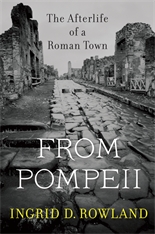
FROM POMPEII:

Ingrid D. Rowland

The Afterlife of a Roman Town

When Vesuvius erupted in 79 CE, the force of the explosion blew the top right off the mountain, burying nearby Pompeii in a shower of volcanic ash. Ironically, the calamity that proved so lethal for Pompeii's inhabitants preserved the city for centuries, leaving behind a snapshot of Roman daily life that has captured the imagination of generations.
The experience of Pompeii always reflects a particular time and sensibility, says Ingrid Rowland. From Pompeii: The Afterlife of a Roman Town explores the fascinating variety of these different experiences, as described by the artists, writers, actors, and others who have toured the excavated site. The city's houses, temples, gardens—and traces of Vesuvius's human victims—have elicited responses ranging from awe to embarrassment, with shifting cultural tastes playing an important role. The erotic frescoes that appalled eighteenth-century viewers inspired Renoir to change the way he painted. For Freud, visiting Pompeii was as therapeutic as a session of psychoanalysis. Crown Prince Hirohito, arriving in the Bay of Naples by battleship, found Pompeii interesting, but Vesuvius, to his eyes, was just an ugly version of Mount Fuji. Rowland treats readers to the distinctive, often quirky responses of visitors ranging from Wolfgang Amadeus Mozart, Charles Dickens, and Mark Twain to Roberto Rossellini and Ingrid Bergman. Interwoven throughout a narrative lush with detail and insight is the thread of Rowland's own impressions of Pompeii, where she has returned many times since first visiting in 1962. Ingrid D. Rowland is Professor at the University of Notre Dame School of Architecture in Rome.
Available products
Book

Published 2014-03-01 by Harvard University Press

Comments

“[Rowland] constructs an overview of Pompeii's history by collecting the opinions and work of famous figures: artists, writers, musicians, actors, and royalty, including Renoir, Mozart, Ingrid Bergman, and Crown Prince Hirohito of Japan. All of the individuals included experienced Pompeii and its environs firsthand—though some, like Mark Twain and Charles Dickens, did not always see them in a positive light. Rowland's work, replete with lyrical verse and beautiful descriptions of Southern Italy, highlights potential problems with preservation, and it wistfully captures the atmosphere of a place both beautiful and dangerous.”

“[A] lively book For Pompeii is not really frozen in time. The achievement of Rowland's book is precisely to show it at the heart of a turbulent, ever-changing region, where the landscape and people are forever caught up in transformation and drama—whether geological, political, technological or cultural. She beautifully evokes the connections between the local, the international, the spiritual and the seismic For Rowland, Pompeii is the fount from which innumerable rivulets of history flow, and her fluent and engaging writing follows them where it will This is a vivid and stimulating account of the history of a corner of the earth where there seems too much colorful humanity ever to be adequately captured in a single book. Rowland's brimming pages show there are plenty more treasures to be excavated from the fertile volcanic soil of its history.”—Rebecca Langlands,

“[Rowland's] book is a personal, indeed highly selective, account of what many researchers, cultivated visitors, archaeologists and even urban reformers have made of the site and the modern town of Pompeii: It reads, all told, like a collection of entertaining essays. She handles her theme with an ease and authority that should please others who are fond of Campania, the Neapolitan region, an area of great beauty and equally great social and environmental problem Rowland covers a wide range of topics, including the creation of the modern town of Pompeii, the musings of tourists like Dickens and Mark Twain, and diverse aspects of Neapolitan folklore.”—Dan Hofstadter,

“Elegant, witty and beautifully produced It is less a guide than an overtly aesthetic appreciation of the site and its environs, poetic in its sense of connections over time It is more the gap between individual drama and universal catastrophe, both inside Pompeii and looking on from outside, that Rowland's account so powerfully conjures up.”—Emily Gowers,

“This is a book difficult, even impossible, to summarize Rowland's enthusiasm for her subject and her knowledge of history are such that many will find interest and pleasure in dipping into it, pulling out a plum here or there.”—Allan Massie,

“Its historical breadth and richness notwithstanding, From Pompeii is a surprisingly intimate book. Rowland begins with her first encounter with Herculaneum as an 8-year-old with a Brownie Starmite camera From Pompeii is thus a personal, even idiosyncratic, introduction to Pompeii in the mode of, say, the novelist E. M. Forster's Alexandria: A History and a Guide If you have any interest in Pompeii, or in entertaining scholarship, or in Italian culture, you'll want to set aside a few evenings for this deeply engaging work of popular history.”—Michael Dirda,

“The book is an enjoyable read that encompasses an exciting range of topics in political and social history Recommended for general readers who want to know more about a place that continues to haunt the imagination of nearly everyone who visits it.”—Linda Frederiksen,

“[An] engaging look at the allure of an ancient city.”—Vanessa Bush