| Vendor | |
|---|---|

|
Fritz Agency
Christian Dittus |
| Original language | |
| English | |
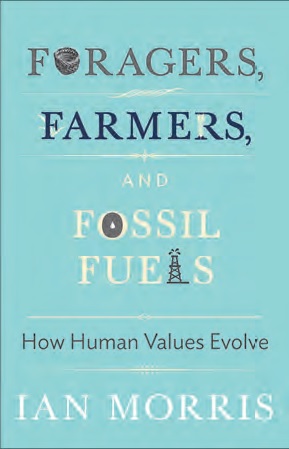
FORAGERS, FARMERS, AND FOSSIL FUELS
How Human Values Evolve
Most people in the world today think democracy and gender equality are good, and that violence and wealth inequality are bad. But most people who lived during the 10,000 years before the nineteenth century thought just the opposite. Drawing on archaeology, anthropology, biology, and history, Ian Morris, author of the best-selling Why the West RulesFor Now, explains why. The result is a compelling new argument about the evolution of human values, one that has far-reaching implications for how we understand the pastand for what might happen next.
Fundamental long-term changes in values, Morris argues, are driven by the most basic force of all: energy. Humans have found three main ways to get the energy they needfrom foraging, farming, and fossil fuels. Each energy source sets strict limits on what kinds of societies can succeed, and each kind of society rewards specific values. In tiny forager bands, people who value equality but are ready to settle problems violently do better than those who aren't; in large farming societies, people who value hierarchy and are less willing to use violence do best; and in huge fossil-fuel societies, the pendulum has swung back toward equality but even further away from violence. But if our fossil-fuel world favors democratic, open societies, the ongoing revolution in energy capture means that our most cherished values are very likely to turn outat some point fairly soonnot to be useful any more.
Ian Morris is the Willard Professor of Classics and a fellow of the Stanford Archaeology Center at Stanford University. He has directed excavations in Italy and Greece and has published thirteen previous books.
Edited and with an introduction by Stephen Macedo
With commentary by Margaret Atwood, Christine M. Korsgaard, Richard Seaford & Jonathan D. Spence
BEUTE, ERNTE, oeL
Deutsch von Juergen Neubauer
[ HC DVA 01/2020]
Fundamental long-term changes in values, Morris argues, are driven by the most basic force of all: energy. Humans have found three main ways to get the energy they needfrom foraging, farming, and fossil fuels. Each energy source sets strict limits on what kinds of societies can succeed, and each kind of society rewards specific values. In tiny forager bands, people who value equality but are ready to settle problems violently do better than those who aren't; in large farming societies, people who value hierarchy and are less willing to use violence do best; and in huge fossil-fuel societies, the pendulum has swung back toward equality but even further away from violence. But if our fossil-fuel world favors democratic, open societies, the ongoing revolution in energy capture means that our most cherished values are very likely to turn outat some point fairly soonnot to be useful any more.
Ian Morris is the Willard Professor of Classics and a fellow of the Stanford Archaeology Center at Stanford University. He has directed excavations in Italy and Greece and has published thirteen previous books.
Edited and with an introduction by Stephen Macedo
With commentary by Margaret Atwood, Christine M. Korsgaard, Richard Seaford & Jonathan D. Spence
BEUTE, ERNTE, oeL
Deutsch von Juergen Neubauer
[ HC DVA 01/2020]
| Available products |
|---|
|
Book
Published 2015-04-01 by Princeton University Press |