| Vendor | |
|---|---|

|
Mohrbooks Literary Agency
Sebastian Ritscher |
| Original language | |
| English | |
| Categories | |
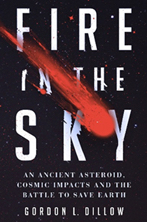
FIRE IN THE SKY
An Ancient Asteroid, Cosmic Impacts and the Battle to Save Earth
For readers of Neil de Grasse Tyson, FIRE IN THE SKY combines history, pop science and in-depth reportage to uncover fascinating new details about asteroids that hit Earth long ago, asteroids streaming toward us now, and the defenses being prepared against asteroid-caused catastrophe.
Dillow warns that one of these days the Earth will be hit by a comet or asteroid of potentially catastrophic size. The only question is when.
Every country in the world has been hit by an asteroid at some point over the course of time, and many are currently involved in "planetary defense" programs designed to track and if necessary try to divert Earth-approaching asteroids.
In the meantime, we need to get much better at finding objects hurtling our way, and if they're large enough to penetrate the atmosphere without burning up, figure out what to do about them.
To the famed Meteor Crater, a mile-wide dimple on the Colorado Plateau created by an asteroid hit 50,000 years ago, we owe many of science's most important discoveries. In the book, Dillow unpacks what the Crater has to tell us. Prior to the Crater's being closely examined in the early 1900's, the world believed that all craters - on the Earth and Moon - were formed by volcanic activity. Not so. The revelation that Meteor Crater and others like it were formed by impacts with space objects has led to a now accepted theory about what killed off the dinosaurs, and it has opened up a new field of asteroid observation, which has recently brimmed with urgency.
Particularly chilling was scientists' observation in the 1990's of a comet impacting with Jupiter. It left a 7,000 mile scar on the Red Planet (ominous given that the Earth is only 7,900 miles in diameter).
On a mission to assess how precarious Earth's situation actually is, Dillow looks at great asteroid hits of the past, which foretell the damage that can be done, and spends time with modern-day asteroid hunters and defense planning experts, including America's first Planetary Defense Officer.
At once a riveting work of popular science and a warning to not take for granted the space objects hurtling overhead, Fire in the Sky is, above all, a testament to our universe's celestial wonders. While Dillow makes clear that the objects above can be deadly, he consistently inspires awe with his descriptions of their size, makeup, and origins.
Gordon L. Dillow has been a reporter, columnist, and war correspondent for more than thirty years. He has written for a number of newspapers, including the Orange County Register, the Los Angeles Times, and the Los Angeles Herald Examiner, and is the coauthor of Where the Money Is, Uppity, and Blue on Blue, as well as other collaborations. This is his first solo work. He lives in Scottsdale, Arizona.
Every country in the world has been hit by an asteroid at some point over the course of time, and many are currently involved in "planetary defense" programs designed to track and if necessary try to divert Earth-approaching asteroids.
In the meantime, we need to get much better at finding objects hurtling our way, and if they're large enough to penetrate the atmosphere without burning up, figure out what to do about them.
To the famed Meteor Crater, a mile-wide dimple on the Colorado Plateau created by an asteroid hit 50,000 years ago, we owe many of science's most important discoveries. In the book, Dillow unpacks what the Crater has to tell us. Prior to the Crater's being closely examined in the early 1900's, the world believed that all craters - on the Earth and Moon - were formed by volcanic activity. Not so. The revelation that Meteor Crater and others like it were formed by impacts with space objects has led to a now accepted theory about what killed off the dinosaurs, and it has opened up a new field of asteroid observation, which has recently brimmed with urgency.
Particularly chilling was scientists' observation in the 1990's of a comet impacting with Jupiter. It left a 7,000 mile scar on the Red Planet (ominous given that the Earth is only 7,900 miles in diameter).
On a mission to assess how precarious Earth's situation actually is, Dillow looks at great asteroid hits of the past, which foretell the damage that can be done, and spends time with modern-day asteroid hunters and defense planning experts, including America's first Planetary Defense Officer.
At once a riveting work of popular science and a warning to not take for granted the space objects hurtling overhead, Fire in the Sky is, above all, a testament to our universe's celestial wonders. While Dillow makes clear that the objects above can be deadly, he consistently inspires awe with his descriptions of their size, makeup, and origins.
Gordon L. Dillow has been a reporter, columnist, and war correspondent for more than thirty years. He has written for a number of newspapers, including the Orange County Register, the Los Angeles Times, and the Los Angeles Herald Examiner, and is the coauthor of Where the Money Is, Uppity, and Blue on Blue, as well as other collaborations. This is his first solo work. He lives in Scottsdale, Arizona.
| Available products |
|---|
|
Book
Published 2019-06-01 by Scribner |
|
Book
Published 2019-06-01 by Scribner |